Domino Games: Which One to Play, Compared by Players and Set
Domino games fall into five families. Blocking and draw games are won by emptying your hand. Scoring games pay points whenever the open ends add up right. Train games like Mexican Train and Chicken Foot seat big groups with bigger sets. Texas 42 takes tricks like a card game. Solitaires and logic puzzles such as Pips are played alone. Most of them use the 28-tile double-six set.

By Sukie · Puzzle editor
Domino game picker
Choose how many people are playing, the set you own, and the kind of game you want. The list updates as you change any option.
8 games fit 4 players with a double-six set.
| Game | Tiles each | Set it uses | Goal |
|---|---|---|---|
| Block Dominoes | 5 | double-six | Play out your hand, or hold the fewest pips when nobody can move |
| Draw Dominoes | 6 | double-six | Play out your hand, or hold the fewest pips when the game blocks |
| Matador | 7 | double-six | Be first to play every tile in your hand |
| All Fives | 5 | double-six | Score points whenever the open ends total a multiple of five |
| Muggins | 5 | double-six | Score the open-end total each time it is a multiple of five |
| Fives and Threes | 5 | double-six | Reach exactly 61 first, pegging on a cribbage board |
| Bergen | 5 | double-six | Score by making the two ends of the line show the same number |
| Texas 42 | 7 | double-six | Make your bid by winning tricks and the five "count" tiles |
The picker reads the same table as the rest of this page: each game's player counts, set and deal come from its rules page on pagat.com, read November 7, 2026. A bigger set always contains a smaller one, so a double-nine owner can play every double-six game by setting aside the 27 tiles that show a 7, 8 or 9.
How the families differ
A domino set is just tiles, so the same box supports games that have almost nothing in common. John McLeod's overview of domino mechanics on pagat.com calls connecting games, where players lay matching tiles into a line that starts in the middle of the table, “the most common domino games.” Almost everything on this page is a connecting game. What separates them is the answer to three questions, and once you know those answers you can pick up any new rule set in minutes.
- What happens when you cannot play? In a block game you pass. In a draw game you take tiles from the boneyard (the face-down leftovers) until you can. In a train game you mark your own line as open for everyone else to use.
- When do points change hands? In blocking and train games, only at the end of a hand, by counting the pips left in each hand. In scoring games, every single play can score if it leaves the right total on the open ends.
- How many ends can the layout have? A simple line has two. A spinner (a double that can be played off on all four sides) gives four. Chicken Foot doubles sprout three branches, and Mexican Train gives every player a line of their own.
If you are new to the tiles themselves (what a suit is, what a blank is worth, why a double sits crosswise), read the guide to domino pips first. How many dominoes are in a set matters here as well, because the set you own decides which games are open to you: pagat lists 6, then 9, then 12 as the most common sizes, which is exactly 28, 55 and 91 tiles.
Blocking and draw games: get rid of your tiles
These are the games most people mean when they say “dominoes.” Each player takes a hand, someone sets the first tile, and play goes around the table matching one open end or the other. The hand stops when a player plays their last tile, or when the line is blocked and nobody can move. Everyone then counts the pips left in their hand. The lowest hand wins and, in pagat's version, is credited with the losers' total minus its own. A tie for lowest scores nothing.
Block Dominoes
2–4 (4 as individuals or partners) players · tiles each: double-six — 2p: 7, 3p: 5, 4p: 5 · plays to 100 (two players or partners); 61 (three or four) · rules: pagat.com — Block Dominoes
Block is the purest version. With two players each takes seven tiles. With three or four each takes five. The tiles nobody takes stay face down and are never used, so a stuck player has nothing to do but pass. That makes the opening hand matter a great deal, and it rewards counting: with 28 tiles and only seven of each number, you can often work out that an end is dead before anyone admits it.
Draw Dominoes
2–4 (4 as individuals or partners) players · tiles each: double-six — 2p: 7, 3p: 7, 4p: 6 · plays to 100 (two players or partners); 61 (three or four) · rules: pagat.com — Draw Dominoes
Draw changes one rule and changes the feel completely. A player who cannot play, or chooses not to, draws from the boneyard until they hold a playable tile, stopping only when two tiles remain there. Hands are bigger at the start (seven each for two or three players, six for four), and nobody is ever simply locked out early, which is why Draw is the friendlier choice for children and new players.
Matador
4 (individuals or partners) players · tiles each: double-six — 4p: 7 · plays to 100 · rules: pagat.com — Matador
Matador throws out the matching rule. Instead of equal numbers touching, the two touching ends must add up to seven, so a 4 is answered with a 3 and a 6 with a 1. Four tiles break the rule: the 0-0, 1-6, 2-5 and 3-4 are the matadors and can be played anywhere. A blank end can only be closed by a matador, which makes holding one a real decision. Pagat describes the four-handed game, with seven tiles each, and notes that larger sets work too: touching ends then add to ten on a double-nine set and thirteen on a double-twelve. Scoring is the same lowest-hand-wins count used in Block, to 100.
How to play dominoes walks through a full Block or Draw hand from the shuffle to the count, and the two-player guide covers what changes when only two of you are at the table, where the boneyard is large and memory does most of the work.
Scoring games: make the ends count
In a scoring game the end-of-hand count still happens, but the real action is during play. After each tile, someone adds up the open ends of the layout, and if the total fits the game's rule, the player who just played scores on the spot. A double on an end counts both of its halves, so a 5-5 sitting crosswise is worth 10, not 5. That one rule is why doubles are so valuable in these games.
All Fives
2–4 (2 is the North American tournament game) players · tiles each: double-six — 2p: 9, 3p: 7, 4p: 5 · plays to 250 (two players); 200 (three or four) · rules: pagat.com — All Fives
All Fives scores any end total that is a multiple of five: 5, 10, 15 and so on up to 35. The first double played becomes the spinner, so the layout grows up to four arms and the totals can climb. Pagat notes the game also goes by Double Six, Muggins, Five Up and Single Spinner, which is a large part of why people disagree about the rules at the table. Two players take nine tiles each, three take seven, four take five.
Muggins
2–4 (4 may play as partners) players · tiles each: double-six — 2p: 7, 3p: 5, 4p: 5 · plays to 250 (two players or partners); 200 (three or four) · rules: pagat.com — Muggins
Pagat keeps the name Muggins for a simpler line game. Doubles are still laid crosswise, but they are not spinners, so the layout only ever has two ends and the largest possible total is lower. The deal matches Block (seven tiles each for two players, five for three or four), and the score targets match All Fives. If your family plays “Muggins” without a four-way double, this is the game you are playing.
Fives and Threes
2–4 (4 usually as two partnerships) players · tiles each: double-six — 2p: 7, 3p: 5, 4p: 5 · plays to exactly 61 (variants 31 or 121) · rules: pagat.com — Fives and Threes
Fives and Threes pays for multiples of three as well as five, and scores the number of times each fits rather than the total. An end total of 6 scores 2, 9 scores 3, 10 scores 2, 12 scores 4, and 15 scores 8, because 15 is five threes and three fives at once. The game is pegged on a cribbage board to exactly 61, and a score that would overshoot is ignored, so the last few points are a puzzle of their own. There is no drawing, and a player who plays out gets one extra point.
Illustrative worked example (not a real game record)
The open ends show a 6 and a 3, a total of 9. In All Fives or Muggins that scores nothing, because 9 is not a multiple of five. In Fives and Threes it scores 3, because 9 is three threes. Now a player lays the 3-3 crosswise on the 3 end. The ends are the 6 and the double, which counts as 3 + 3 = 6, for a total of 12. All Fives: still nothing. Fives and Threes: 4 points, because 12 is four threes. The same tiles on the same table score completely differently depending on which game you agreed to play.
Bergen
2–4 players · tiles each: double-six — 2p: 6, 3p: 6, 4p: 5 · plays to 15 (two players); 10 (three or four) · rules: pagat.com — Bergen
Bergen ignores totals and looks at whether the ends match each other. Making both ends show the same number is a double-header, worth 2 points. Making them match when one end is a double is a triple-header, worth 3. Winning the hand is worth 2 more. Games are short: 15 points for two players and 10 for three or four. Hands are small too, six tiles each for two or three players and five for four, with a draw from the boneyard when you are stuck. It is the quickest scoring game here and a good bridge from Block to the counting games.
Counting the score correctly is where most house arguments start. How to score dominoes lays out the end-of-hand count and the in-play scoring side by side, with the rounding rules each game uses.
Train and tree games for a crowded table
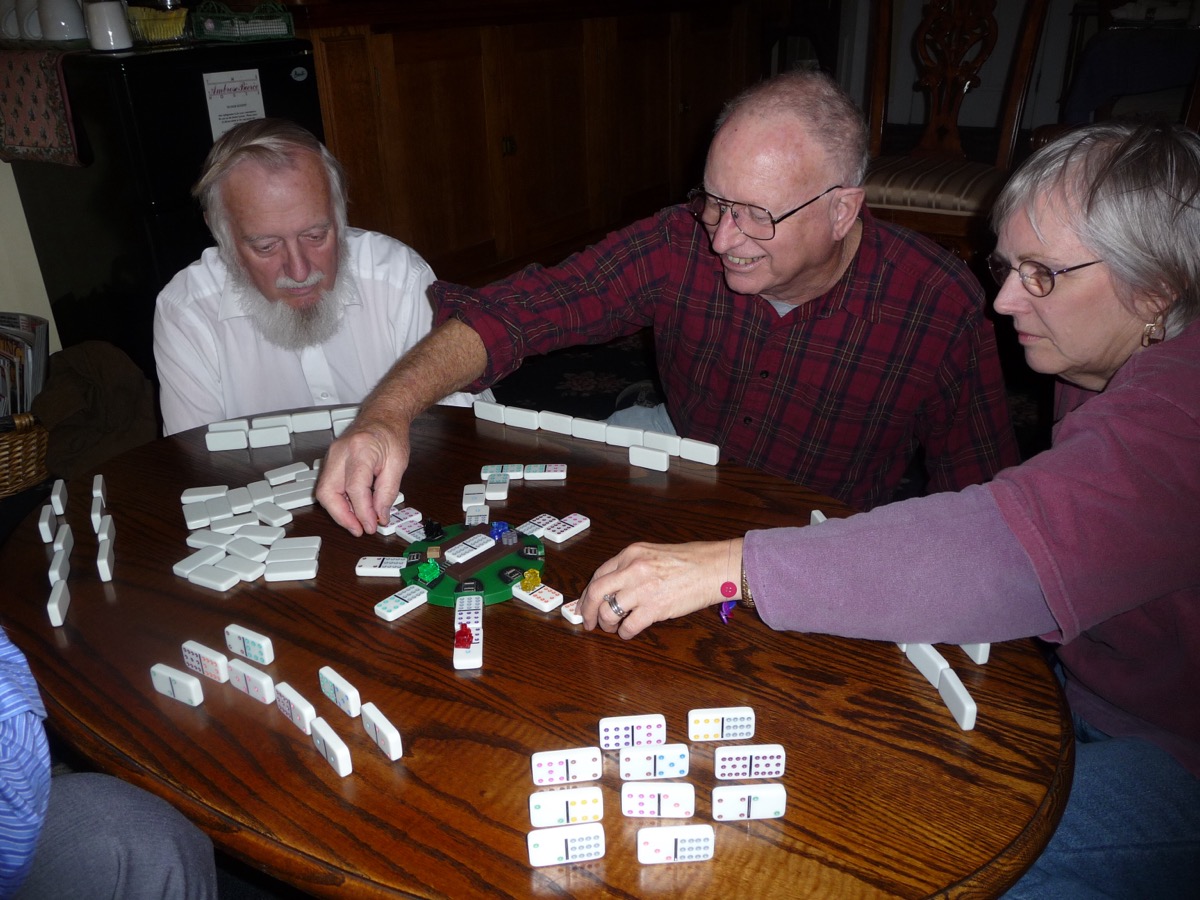
Once more than four people want to play, a double-six set runs out of tiles. Train and tree games solve that with bigger sets and layouts that give each player somewhere to go. They also share a scoring idea: every hand, you are charged the pips you are still holding, and after a fixed number of hands the lowest total wins. One bad hand is survivable, which suits a long, social evening.
Mexican Train
2–10 (best with four or more) players · tiles each: double-twelve — 2p: 15, 3p: 15, 4p: 15, 5p: 12, 6p: 12, 7p: 10, 8p: 10, 9p: 8, 10p: 8 · plays to 13 games, starting from 12-12 and stepping down to 0-0 · rules: pagat.com — Mexican Train
Mexican Train uses a double-twelve set of 91 tiles. The deal shrinks as the table grows: 15 tiles each for two to four players, 12 for five or six, 10 for seven or eight, and 8 for nine or ten. Each player builds a private train from the central double. A player who cannot play puts a marker on their train, and from then on anyone may add to it until the owner plays there again. A shared Mexican train is open to everyone from the second turn on. Playing a double means you must play again to cover it, and an uncovered double has to be satisfied by the next players before anything else happens. A full game is 13 hands, starting with the 12-12 and stepping down one double each hand to the 0-0.
Chicken Foot
2 or more (best with four or more) players · tiles each: double-six — 2p: 5, 3p: 5; double-nine — 2p: 20, 3p: 14, 4p: 11, 5p: 9, 6p: 7; double-twelve — 4p: 18, 5p: 14, 6p: 12, 7p: 10, 8p: 9 · plays to ends when the 0-0 has been the starting double (ten hands with a double-nine set) · rules: pagat.com — Chicken Foot
Chicken Foot is the train game you can play with a double-nine set, which pagat calls the normal choice. Its signature rule is the foot itself: whenever a double is played, three more tiles must be laid off it before play can go anywhere else, and that includes the starting double. The 0-0 is the dangerous tile to be caught with, worth 50 points (25 in one variation). With a double-nine set the deal runs from 20 tiles each for two players down to 7 each for six, and the game ends after ten hands, when the 0-0 has been the starting double. Two or three players can scale down to a double-six set with five tiles each, and up to eight can play with a double-twelve.
Texas 42: dominoes played like cards
Texas 42
4, in two fixed partnerships players · tiles each: double-six — 4p: 7 · plays to 7 marks · rules: pagat.com — Forty-Two
Forty-Two, also known as Texas 42, has no line at all. Four players in fixed partnerships take seven tiles each and play tricks, much like Spades or Bridge. Each player gets one chance to bid, from 30 up to 41 or in marks (one mark equals 42), and the high bidder names trumps. Five tiles carry extra points: the 5-5 and 6-4 are worth 10 each, and the 5-0, 4-1 and 3-2 are worth 5. Add one point for each of the seven tricks and every hand is worth exactly 20 + 15 + 7 = 42, which is where the name comes from. The first team to seven marks wins. If your group already likes bidding card games, this is the domino game to try next.
Domino games for one: solitaires and logic puzzles
A set of tiles is also a solo puzzle kit. Pagat's solitaire section describes these as games that “involve moving tiles around a tableau,” won when every tile is played or the tableau reaches a set pattern. It also points to a separate tradition of placement puzzles, where dominoes go onto a grid of squares, and totaling puzzles, where the numbers have to add up.
The Seven Pis
1 players · tiles each: double-six — 1p: 3 · plays to zero tiles left over · rules: pagat.com — The Seven Pis
The Seven Pis is a good example of the first kind. It was designed for a double-six set. You never see more than three tiles at once; after each turn you refill to three from a face-down pile, and the aim is to lay every tile into seven π-shaped groups. Your score is the number of tiles you could not place, so zero is a perfect game.
Pips (logic puzzle)
1 players · tiles each: double-six — tray set by the puzzle · plays to solve the board · rules: Free daily board on EnergyPips
Pips is the second kind: a logic puzzle built from domino tiles. You get a small tray of tiles from the double-six set, never more than one of each, and a grid split into colored regions. Each region carries a rule about the pips inside it, such as an exact sum, all values equal, or all different. There is no opponent and no luck, only deduction, and a domino may lie across two regions with each half counting toward its own. The free daily pips game on the homepage is the quickest way to try it, the how-to-play guide explains the badges, and if you like the format, games like pips compares the other logic puzzles players move on to. Every rule on a Pips board is a rule about pip counts, which is also why the dot on a domino has a name of its own.
Every game side by side: set, players and objective
The table below collects the facts from each rules page in one place. Read it across to compare two games, or down a column to see, for example, how few games need anything bigger than a double-six set.
| Game | Family | Players | Set and tiles each | Objective | The rule that sets it apart |
|---|---|---|---|---|---|
| Block Dominoes | Blocking and draw | 2–4 (4 as individuals or partners) | double-six — 2p: 7, 3p: 5, 4p: 5 | Play out your hand, or hold the fewest pips when nobody can move | No drawing: a player who cannot match an end simply passes |
| Draw Dominoes | Blocking and draw | 2–4 (4 as individuals or partners) | double-six — 2p: 7, 3p: 7, 4p: 6 | Play out your hand, or hold the fewest pips when the game blocks | A player who cannot play draws from the boneyard until able to, leaving the last two tiles |
| Matador | Blocking and draw | 4 (individuals or partners) | double-six — 4p: 7 | Be first to play every tile in your hand | Touching ends must add up to 7; the 0-0, 1-6, 2-5 and 3-4 are wild "matadors" |
| All Fives | Scoring | 2–4 (2 is the North American tournament game) | double-six — 2p: 9, 3p: 7, 4p: 5 | Score points whenever the open ends total a multiple of five | The first double played is a spinner, so the layout can grow in four directions |
| Muggins | Scoring | 2–4 (4 may play as partners) | double-six — 2p: 7, 3p: 5, 4p: 5 | Score the open-end total each time it is a multiple of five | Doubles are laid crosswise but are not spinners: the line only has two ends |
| Fives and Threes | Scoring | 2–4 (4 usually as two partnerships) | double-six — 2p: 7, 3p: 5, 4p: 5 | Reach exactly 61 first, pegging on a cribbage board | Score the number of fives and threes in the end total: 15 scores 8 (five threes plus three fives) |
| Bergen | Scoring | 2–4 | double-six — 2p: 6, 3p: 6, 4p: 5 | Score by making the two ends of the line show the same number | Equal ends score 2 (a double-header); equal ends with a double on one of them score 3 (a triple-header) |
| Mexican Train | Trains and trees | 2–10 (best with four or more) | double-twelve — 2p: 15, 3p: 15, 4p: 15, 5p: 12, 6p: 12, 7p: 10, 8p: 10, 9p: 8, 10p: 8 | Lowest total of pips left in hand after 13 games | Each player builds a private train; a stuck player marks theirs open, and a shared Mexican train is open to all |
| Chicken Foot | Trains and trees | 2 or more (best with four or more) | double-six — 2p: 5, 3p: 5; double-nine — 2p: 20, 3p: 14, 4p: 11, 5p: 9, 6p: 7; double-twelve — 4p: 18, 5p: 14, 6p: 12, 7p: 10, 8p: 9 | Score as few points as possible; the 0-0 left in hand costs 50 | Every double must get three more tiles — the chicken foot — before play goes anywhere else |
| Texas 42 | Trick-taking | 4, in two fixed partnerships | double-six — 4p: 7 | Make your bid by winning tricks and the five "count" tiles | Players bid 30 to 42 or in marks; the high bidder names trumps. Each hand is worth 42 points |
| The Seven Pis | Solo | 1 | double-six — 1p: 3 | Use every tile to build seven π-shaped groups; your score is the tiles left over | You hold three tiles at a time, refilled from a face-down pile after each turn |
| Pips (logic puzzle) | Solo | 1 | double-six — tray set by the puzzle | Place every tile in the tray on the grid so each colored region obeys its rule | No opponent and no luck: the tray and the board are fixed before you start, and every tile must be placed |
| Set you own | 1 | 2 | 3 | 4 | 5 | 6 | 7 | 8 | 9 | 10 |
|---|---|---|---|---|---|---|---|---|---|---|
| double-six (28) | 2 | 7 | 7 | 8 | 0 | 0 | 0 | 0 | 0 | 0 |
| double-nine (55) | 2 | 7 | 7 | 9 | 1 | 1 | 0 | 0 | 0 | 0 |
| double-twelve (91) | 2 | 8 | 8 | 10 | 2 | 2 | 2 | 2 | 1 | 1 |
What the grid tells you about sets
The coverage grid makes one thing plain: a double-six set peaks at four players and stops dead at five. A double-six set has 28 tiles, and four hands of five, six or seven leave a boneyard of eight, four or none. A fifth hand of five would leave three tiles, too few for the draw games, and none of the rules here deal five hands from 28 tiles. Every row grows as the set gets bigger, because a bigger set adds games without taking any away.
The arithmetic of set sizes explains the jump. A double-n set has (n + 1)(n + 2) / 2 tiles, as MathWorld sets out: 28 for double-six, 55 for double-nine, 91 for double-twelve. Every bigger set contains the smaller ones whole, so moving up never costs you a game. Taking a double-twelve set down to a double-six means setting aside 91 − 28 = 63 tiles, and down to a double-nine means setting aside 36.
So, if you are buying one set: a double-six covers every blocking, scoring and trick-taking game on this page and both solo games. A double-twelve adds Mexican Train and big-table Chicken Foot and still plays everything else once you take out the high tiles; it is just a heavier box and a longer setup. A double-nine sits in between and is the natural Chicken Foot set. For the full count of tiles and pips in each size, see how many dominoes are in a set; for the history of the tiles and the wider list of regional games, the Wikipedia list of domino games is a good map, and Britannica's dominoes entry covers where the game came from.
A note on house rules. Every game above has regional versions, and pagat records many of them on the same pages linked here. When a table argues about whether a double is a spinner or whether you must draw, the fastest fix is to name the game from this catalogue, agree on its rules page, and play. If you only have a few minutes and no set at all, the daily pips puzzle needs nothing but a browser.
Keep reading
- The = ruleWhat the equal sign means in pips, and how it differs from a sum badge.
- Play pips online freeIn the browser, no account and nothing to install.
- Pips strategyOpening theory, elimination, and the mistakes that cost the most time.
- How to play NYT PipsThe rules, and what measuring every published board says about the difficulties.
Or go back to today's pips puzzle.