Mexican Train Dominoes Rules
Mexican train dominoes rules in short: use a double-twelve set and deal 15 tiles each to up to four players (fewer for bigger tables). The round's double sits in the middle as the engine. On your turn, add one matching tile to your own train, to the shared Mexican train, or to any train with a marker on it. Draw once if you can't play. A double must be covered before anything else. Leftover pips are penalty points, and after 13 rounds, 12-12 down to 0-0, the lowest total wins.
The rest of this page is the detail behind that paragraph. These Mexican train dominoes rules follow John McLeod's Mexican Train page on pagat.com, which lists regional variants separately, with the places where published rule sets disagree marked as variants. Use the round helper below to get the deal for your table.

By Sukie · Puzzle editor

What goes on the table
Mexican Train is a draw game for a double-twelve set: 91 tiles, one for every pairing of the values 0 to 12, including the thirteen doubles. Each value appears on 14 tile halves, so the set carries 1,092 pips in all, an average of exactly 12 per tile. That average matters later, because the pips left in your hand are your score. The arithmetic behind those set sizes is on the page about how many dominoes are in a set.
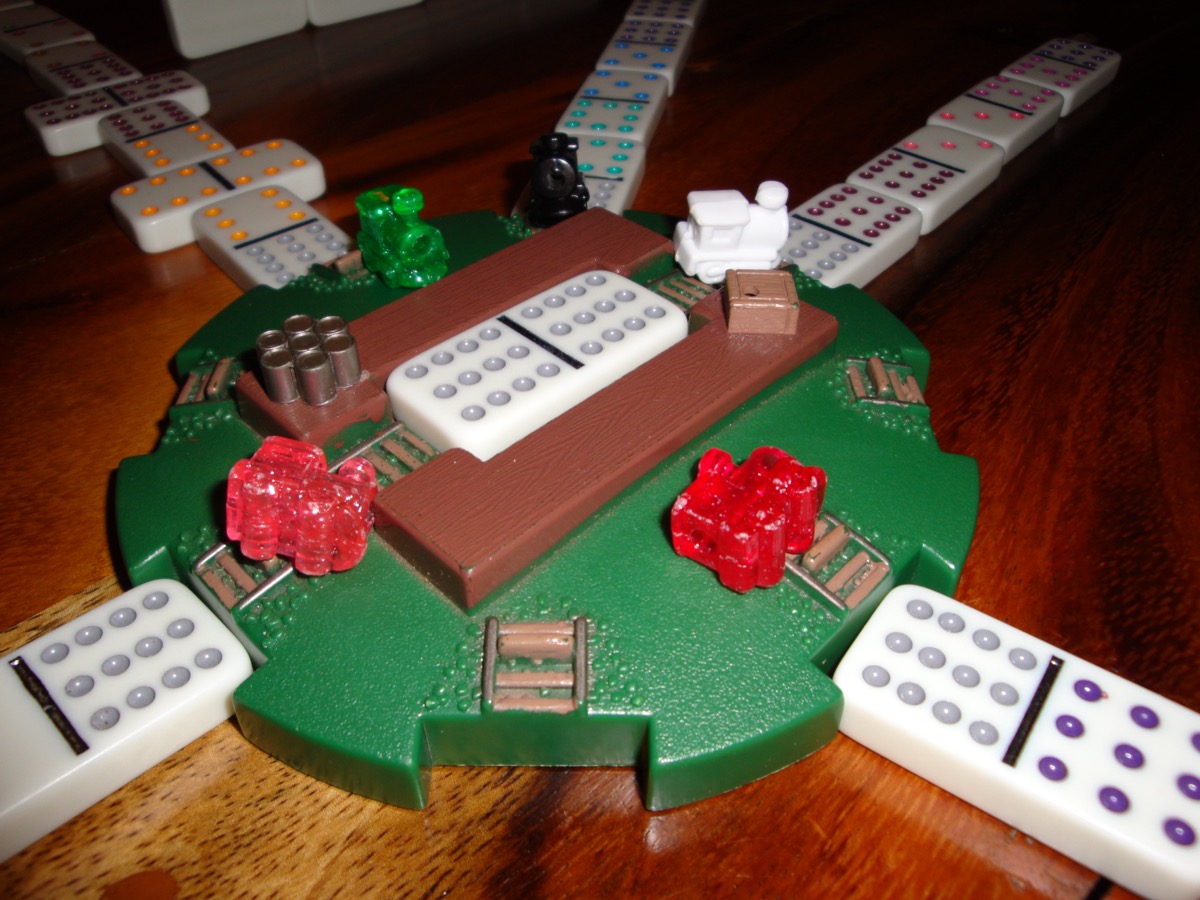
Besides the tiles you need one marker per player and one more for the Mexican train. pagat.com describes the traditional kit as a penny for each player and a nickel for the Mexican train. Boxed sets often swap the coins for small plastic locomotives, like the ones in the photo. A central hub (the “station”) with notches for each train keeps the layout tidy, but Wikipedia's Mexican Train article notes that it is optional. A pencil and paper for the running score completes the list.
The deal: tiles per player from 2 to 10
Hand size shrinks as the table grows, so the boneyard never runs dry too early. pagat.com gives four bands. The boneyard columns are simple subtraction from 91, once for dealing the whole set and once for setting the engine aside first.
| Players | Tiles each | Dealt in total | Boneyard (all 91 dealt from) | Boneyard (engine set aside) |
|---|---|---|---|---|
| 2 | 15 | 30 | 61 | 60 |
| 3 | 15 | 45 | 46 | 45 |
| 4 | 15 | 60 | 31 | 30 |
| 5 | 12 | 60 | 31 | 30 |
| 6 | 12 | 72 | 19 | 18 |
| 7 | 10 | 70 | 21 | 20 |
| 8 | 10 | 80 | 11 | 10 |
| 9 | 8 | 72 | 19 | 18 |
| 10 | 8 | 80 | 11 | 10 |
The three-player line matches the worked example in Wikipedia's article, which follows the 1994 rules: 15 tiles each and 46 left in the boneyard. Ten players take 80 tiles between them and leave only 11, so the late rounds of a big game run short of draws quickly. That is one reason larger groups often move to a double-fifteen set.
Round helper: the deal and the engine for all 13 rounds
A full game is thirteen rounds. Round one opens with the 12-12, round two with the 11-11, and so on down to the double blank in round thirteen. Set your player count and the helper fills in the rest. Step through the rounds as you play so nobody has to remember which double comes next.
Round helper
Pick the number of players and how you find the engine. The helper gives the deal, the boneyard, and the engine double for each of the 13 rounds.
- Tiles each
- 15
- Dealt in total
- 60
- Boneyard
- 31
- Markers
- 5
Boneyard = 91 − 4 × 15. Markers = one per player plus one for the Mexican train. If the engine double lands in the boneyard, players draw until someone finds it, so the hands grow before play starts.
Round 1 of 13: the engine is the 12-12. Each player builds a train that starts with a 12.
| Round | Engine | Opening player (holder of the engine) |
|---|---|---|
| 1 | 12-12 | Whoever holds it |
| 2 | 11-11 | Whoever holds it |
| 3 | 10-10 | Whoever holds it |
| 4 | 9-9 | Whoever holds it |
| 5 | 8-8 | Whoever holds it |
| 6 | 7-7 | Whoever holds it |
| 7 | 6-6 | Whoever holds it |
| 8 | 5-5 | Whoever holds it |
| 9 | 4-4 | Whoever holds it |
| 10 | 3-3 | Whoever holds it |
| 11 | 2-2 | Whoever holds it |
| 12 | 1-1 | Whoever holds it |
| 13 | 0-0 | Whoever holds it |
The station, the engine and the trains
Every round starts from a single double in the middle of the table. Wikipedia calls it the engine, and the hub it sits in is the station; pagat.com simply says “the centre double”. Each player owns one personal train, a line of tiles running from the engine toward their seat. Each new tile must match the open end of the line, and the first tile must carry the engine's number. In the 12-12 round, every train starts with a tile showing a 12.
There is one more line, the Mexican train itself, also called the caboose on pagat. Nobody owns it. Any player can start it from their second turn on, using a tile that matches the engine, and then anyone may add to it. Its marker shows that it is always open. That shared line is what gives the game its name.
Read the diagram the way a player would on their turn. Player A's train ends in a 2 and is private, so only A can extend it. Player B's ends in a 10 and has a marker, so anyone holding a 10 may play there. The Mexican train ends in a 4 and is always open. Normally that gives each player three or four places to play. But Player C's 8-8 is exposed. Until someone lays an 8 on it, it is the only legal place to play.
The first turn is played differently
Under pagat.com's rules the opening turn is special. Starting with the player who placed the engine and going clockwise, each player may lay as many tiles as form a valid line on their own train, all in one go. A strong opening can put half a hand on the table before anyone else has moved. On this first turn nobody may play on another player's train, and nobody may start the Mexican train.
A player who has no tile matching the engine places their marker where their train would begin. From the first player's second turn, anyone may start that train for them. If a first-turn line ends in a double, the double has no effect until everyone has had a first turn. If someone plays out their entire hand on the first turn, play still goes once around the table so everyone gets an opening turn before the round is scored.
Not every table plays it this way. pagat.com lists a variant where tiles go down one at a time from the very first turn. The David Bauguess rules it links to play it that way too, with no special first turn at all. If your group is new to the game, the one-at-a-time opening is easier to follow. The long first-turn train rewards planning your hand as a chain.
Every turn after that: one tile, three kinds of train
From the second turn on, a turn is usually a single tile, and it may go in one of three places:
- your own personal train, marked or not;
- the Mexican train, once someone has started it;
- another player's train, but only while their marker is on it.
If none of those works, draw one tile from the boneyard. If the drawn tile plays, you must play it. If it doesn't, you pass and put your marker on your own train. You cannot draw while holding a playable tile, and you must play if you are able. When the boneyard is empty, a player who cannot play simply passes and puts down their marker.
The marker is what makes the game interactive. While it is on your train, your opponents can feed tiles onto it, which can help you or block you. pagat.com is specific about removing it: the marker comes off only when the owner plays on their own train. If another player adds to it, the marker stays. So a train opened by one bad turn stays open until its owner can play on it again, and a tile you can hold back for your own train is worth more than it looks.
Why does a double have to be satisfied?
Doubles are the rule most tables argue about, so here is the pagat.com version in order. When you play a double after the first turn, you must play another tile in the same turn. It can go on the double or anywhere else you are allowed to play. If that tile is also a double, you play again. Your turn ends when you lay a non-double or have to pass. The exception: if the double is your last tile, you go out and the round is over.
A double still uncovered at the end of a turn must be satisfied. The next tile played anywhere on the table has to go on that double. The duty falls first on the next player, who must cover it even if it sits on a private train they could not otherwise touch. If they cannot, they draw. If the drawn tile still doesn't fit, they pass, put down their marker, and the duty moves to the next player. With two or more doubles exposed, they are satisfied in the order they were played.
Doubles never become junctions in this game. Once one tile has been laid on a double, nothing more can attach beside it. The only exception is the engine, which feeds every train. That is the clearest difference from Chicken Foot, where a double sprouts several branches.
End of the round and scoring
A round ends when one player has played their last tile, or when the layout is blocked and nobody can play. Everyone then counts the pips on the tiles left in their hand. That count is their penalty for the round, and a player who went out scores zero. Scores carry over through all thirteen rounds, and the lowest total at the end wins. For a tie, Wikipedia records a tie-break: the player with more zero-point rounds wins, then the lower non-zero round total.
Illustrative example. Suppose a round ends while you still hold the 12-11, the 6-0 and the 3-3. Your penalty is 23 + 6 + 6 = 35. A second player holding only the 1-0 scores 1. With the set averaging 12 pips a tile, a hand of three tiles would be expected to cost about 36. Thirty-five is ordinary, and the 12-11 alone is two thirds of it. Shedding high tiles early is the main defensive habit, because the round can end on anyone's turn. How pip-count scoring works across other domino games is covered in how to score dominoes.
Counting pips is the same skill the domino pips page covers for the double-six set: each value has a fixed dot pattern, so you read a tile by shape instead of counting dots one by one. On a double-twelve set the higher values add more dots, and some sets color each value differently to make them faster to read.
House variants to settle before the first deal
Disputes in this game usually come from rules nobody agreed at the start. These are the variants the two references list as departures from the standard Mexican train dominoes rules. The source for each is in brackets. None of them is wrong, but mixing two of them halfway through a game will cause trouble.
- Marker comes off when anyone plays on the train, so an open train takes exactly one tile from an opponent before closing again. (pagat)
- Marker comes off when the owner plays anywhere, not only on their own train. (pagat)
- No marker after a forced double. If the owner could not play on their train only because they had to satisfy a double, they don't put down a marker. (pagat)
- Doubles need not be satisfied by the next player at all. (pagat; Wikipedia lists “cover optional”)
- Reverse order: several exposed doubles are satisfied last-played first. (pagat)
- One double per turn, so at most one double is ever exposed. (pagat)
- One tile at a time from the start, with no first-turn train. (pagat)
- Positive scoring: the player who goes out scores the pips left in everyone else's hands, and a blocked round goes to the lowest hand. (pagat)
- Blanks at 25, double blank at 50 instead of zero. Wikipedia attributes this to Mexican Train Fun (2015).
- Branching doubles and continuous draw (keep drawing until you can play) are also listed in Wikipedia's variants. Fundex's rules move the marker back to the hub instead of removing it. (Wikipedia)
Game length is the other thing to settle. Thirteen rounds is a long session. If you want a shorter evening, one way to keep every other rule unchanged is to play only a run of the high doubles, for example 12-12 down to 6-6. Write down which rounds you will play before you start, so the scores stay comparable.
Where Mexican Train sits among domino games
Mexican Train is one of the “train” games, a family where each player builds their own line and the goal is to empty your hand rather than score points during play. Compare the classic block and draw games on a double-six set, where everyone plays onto a single shared line. If you have never played the basic game, start with how to play dominoes. The wider catalogue, from Chicken Foot to Muggins, is on the domino games page.
Some of the same thinking shows up in solo puzzles. Matching numbers, planning which tile goes where, and avoiding a dead end are also the core of a pips board, where you place dominoes into a grid to meet each region's rule. If you want something to do between rounds, today's free pips puzzle takes a few minutes. The what are pips page explains the word itself, and games like pips lists other domino-logic puzzles.
Table disputes, settled
Can you play on another player’s train in Mexican Train?
Only when that train has a marker on it. A player who cannot play on their own train puts a marker on it, and from then on anyone may add to it. The marker stays until the owner plays on their own train again. The one exception is a double that must be satisfied: the next player has to cover it wherever it sits, even on a private train.
What happens if nobody holds the engine double?
Under the pagat.com rules, players draw from the boneyard in turn until someone finds it, and that player places it to start the round. pagat also gives the option of skipping the hunt: take the round’s double out face up before shuffling.
Is the double blank worth 50 points?
Not under the standard rules. A tile is worth its pips, and the double blank has none, so it counts zero. Scoring blanks at 25 and the double blank at 50 is a house variant that Wikipedia attributes to Mexican Train Fun (2015). Agree on it before the first round if your table uses it.
Can you go out by playing a double?
Yes. A double normally obliges you to play another tile, but if the double is your last tile you go out and the round ends at once. Nobody has to satisfy it.
How many people can play Mexican Train with one set?
pagat.com gives a deal for up to ten players from one double-twelve set: 15 tiles each for up to four players, then 12, 10 and 8 as the table grows. Wikipedia’s set table lists double-twelve for 2 to 8 players and a double-fifteen set for 9 to 12, so larger groups often switch sets.
Keep reading
- Play pips online freeIn the browser, no account and nothing to install.
- Pips strategyOpening theory, elimination, and the mistakes that cost the most time.
- How to play NYT PipsThe rules, and what measuring every published board says about the difficulties.
- Games like pipsHonest comparisons with the puzzles pips players move on to.
Or go back to today's pips puzzle.