How to Score Dominoes
How to score dominoes depends on which of two systems your table plays. In block and draw games, points come only at the end of a hand: the player with the fewest pips left wins and scores the pips still held by the others. In All Fives and Muggins, you also score during play, whenever the open ends of the layout add up to a multiple of five.
Everything below comes from the rule pages at pagat.com, John McLeod's rules site, which labels regional variants by name, read in November 2026. Where tables genuinely differ, the variants are named rather than one being picked for you. Use the scorer first if you are mid-game; read on for how each count works.

By Sukie · Puzzle editor
Domino scorer
The left panel scores a single play in All Fives or Muggins. The right panel scores the end of a hand under three rule sets. Both open on this page's worked examples, so you can check the arithmetic against the text.
All Fives / Muggins: score a play
Enter the pips showing on each open end after the tile is laid. Tick “double” for a double lying crosswise on an end — it counts both halves.
12 + 8 = 20
Scores 20 points.
End of hand: count what is left
Enter the pips left in each player’s hand (0 for a player who went out).
Player A wins the hand by going out.
Opponents hold 21 = 21 pips, rounded to 20.
Player A scores 20.
Which kind of game are you scoring?
Before any counting, settle one question: does anything score while tiles are being laid? If the answer is no, you are playing a line game such as block or draw, and the pips only matter once the hand stops. If the answer is yes, you are in the fives family, where the open ends are added up after every tile and the end-of-hand count is a bonus on top. Most arguments at a domino table start because two players learned different answers to that question.
| Game | Scores during play? | End of hand | Spinner | Usual target |
|---|---|---|---|---|
| Block | No | Fewest pips wins; scores losers' pips minus own | None | 100 (2 players or partners); 61 (3–4 players) |
| Draw | No | Same as block | None (doubles laid across) | 100 / 61 |
| Muggins | Yes — two ends, multiples of 5 | Each hand rounded to nearest 5, subtracted from its holder | None | 250 (2 players); 200 (3–4) |
| All Fives | Yes — up to four ends, multiples of 5 | Winner scores opponents' pips rounded to nearest 5 | First double only | 250 (2 players); 200 (3–4); 61 if divided by 5 |
The names are slippery. Pagat notes that All Fives is also called Double Six, Muggins, Five Up or Single Spinner, and that Muggins and Sniff are played more in Britain and Europe while All Fives and Five Up are the American forms. Its fives family overview sorts them by spinners instead of names: no spinner (Muggins), only the first double (All Fives), or every double (Five Up). If your group says “Muggins” but builds a cross off the first double, you are scoring All Fives, and the spinner rules further down apply.
End-of-hand scoring in block and draw
A hand of block dominoes stops when one player lays their last tile (“dominoes”) or when nobody can play. Pagat's rule for the count is short: each player totals the pips on the tiles still in their hand, the lowest total wins, and the winner “is credited with the sum of the scores of the losers, minus his own total.” If two players tie for lowest, nobody scores that hand.
When a player goes out, their own total is zero, so the subtraction does nothing and they simply collect everyone else's pips. The subtraction only bites in a blocked hand, where the winner is still holding tiles. The draw game uses exactly the same count; the only difference is that a stuck player draws from the boneyard before passing, which in pagat's version stops when two tiles are left.
Blocked hands are where tables disagree most. Pagat's draw page lists three ways a blocked winner can be paid, and the difference is not small. Take an illustrative three-player blocked hand in which A is left holding 9 pips, B holds 14 and C holds 22. A has the fewest, so A wins. Then:
| Method | Working | A scores |
|---|---|---|
| Losers' pips minus winner's (the main rule) | 14 + 22 − 9 | 27 |
| Sum of each loser's difference | (14 − 9) + (22 − 9) | 18 |
| All remaining pips, winner's included | 9 + 14 + 22 | 45 |
With only two players the first two methods give the same number, which is why the disagreement rarely shows up until a third person joins. Agree on one before the first hand. Pagat also records older and regional customs: early accounts give the winner just 1 point per hand, and in the Puerto Rican draw game the winner takes the pips left in every other hand while the others score nothing.
Partnership play adds one wrinkle. A team can be declared the winner because one partner went out, or because the team holds the fewest pips between them. Under the second reading, the partner who went out can still lose the hand if the other partner is stuck with heavy tiles. Again, pagat records both; pick one and write it at the top of the score sheet.
Counting a hand quickly is a skill of its own. Because the tiles carry the same pip patterns as dice faces, each half can be read by its shape rather than by counting dots — the domino pips guide covers how a double-six set is built and why it holds 168 pips in total, which is also the number that lets a careful player know how much is still hidden in other hands. If you are unsure which set you are holding, the set sizes are listed here.
Rounding to the nearest five
Block and draw count pips exactly. The fives games do not, because every score made during play is a multiple of five and the end-of-hand count is rounded to match. Pagat's Muggins and All Fives pages give the same example: a hand holding only the 1-2 (three pips) rounds up to 5, while a hand holding only the 1-1 (two pips) rounds down to 0. Pip totals are always whole numbers, so there is never a halfway case: the last digit decides.
| Total ends in | Direction | Examples |
|---|---|---|
| 0 or 5 | Unchanged | 10 → 10, 25 → 25 |
| 1, 2, 6 or 7 | Down | 2 → 0, 21 → 20, 17 → 15 |
| 3, 4, 8 or 9 | Up | 3 → 5, 14 → 15, 19 → 20 |
What happens to the rounded number depends on the game. In All Fives the winner of the hand adds the opponents' combined total, rounded once, to their own score. In Muggins as pagat describes it, every player rounds their own leftover pips and subtracts the result from their own score, so there is no single winner of the count; the player who went out simply loses nothing. Pagat lists the subtraction method as a variant of All Fives too, and notes that it does not suit a cribbage board. The end-of-hand panel in the scorer above has all three modes.
Some tables then divide by five. Pagat describes Muggins players who score 1 point for each five in the count (2 for 10, 3 for 15, 4 for 20), and All Fives players who divide every score by five so it can be pegged on a cribbage board, with 61 as the winning target. The play is identical; only the size of the numbers changes.
Scoring as you play: the open-end count
In every fives game the rule is the same at heart. After you set a tile, add up the pips on the open ends of the layout. If the total is a multiple of five, you score that total immediately. With two ends, the possible scores are 5, 10, 15 and 20. With the four ends of an All Fives cross, they run up to 35.
Doubles are laid crosswise, and a double sitting on the end of an arm counts both of its halves: pagat's examples are a 5-5 worth ten and a 6-6 worth twelve. That is why doubles are the big scoring tiles. In Muggins, which has no spinner, the highest possible play is 20, made by having the 6-6 on one end and the 4-4 on the other — exactly the position in the photograph below.
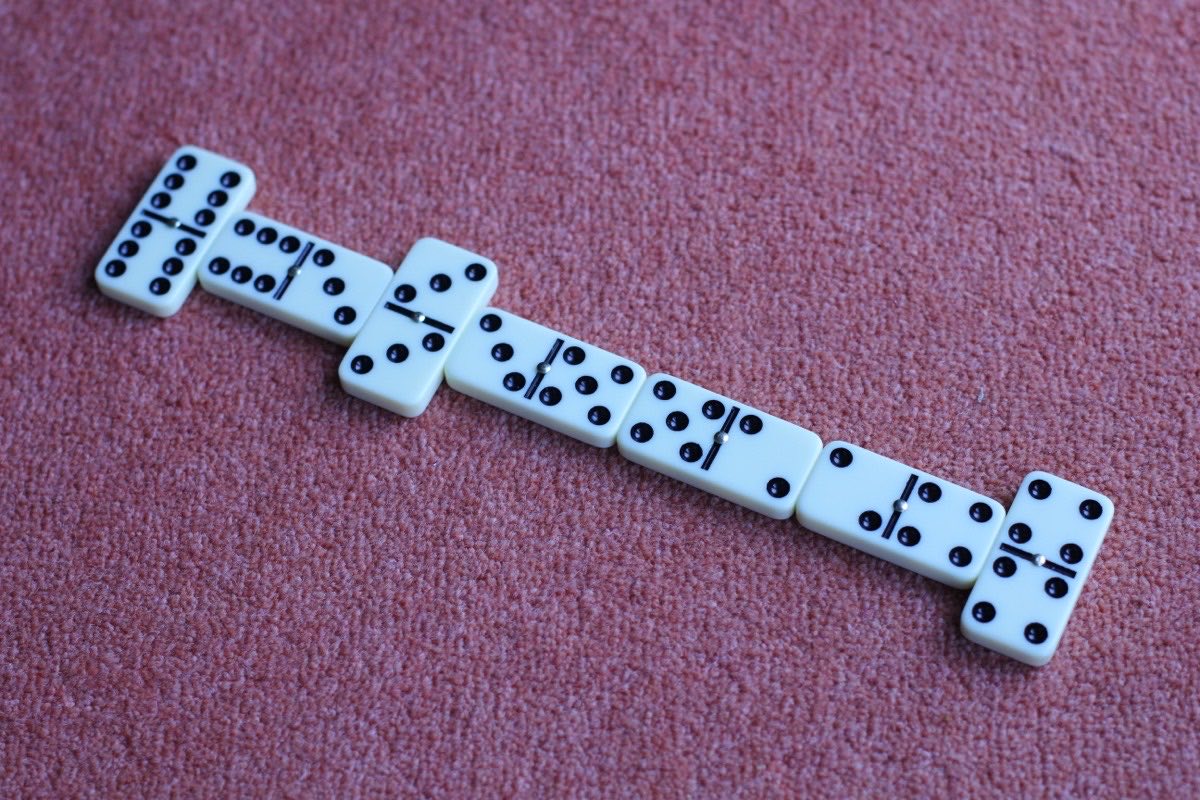
Two habits make the count easier. First, look at the total you are handed, not at the ends one by one: beginners, pagat observes, hunt for an arm ending in five and miss combinations such as a 6 and a 4. Second, remember that you can lower the count as well as raise it. If the ends show a 6-6 double (12) and a 2, the total is 14; covering the 2 with a 2-3 makes 12 + 3 = 15. Pagat's fives family page calls tiles that let you score again off a scoring total “repeaters” — a 1-2 played on a 1-1 at the end of an arm, for instance, swaps the double's 2 for the 2-end of the new tile, so the count does not change and a total that scored for your opponent scores again for you.
How the spinner's ends are counted
In All Fives, the first double played, and only the first, becomes the spinner. The layout can grow off all four of its sides, but in a fixed order: the first two tiles against the spinner go on its long sides, and only then can the third and fourth arms start from its ends. The counting follows that order, and it is the part of domino scoring most often done wrong.
| Stage | What is added | Ends counted |
|---|---|---|
| Spinner alone | Both halves of the spinner (5-5 = 10) | 1 tile |
| One side covered | Spinner's 10 + the new tile's open end | 2 |
| Both sides covered | The two line ends only; the spinner drops out | 2 |
| Third arm started | Two line ends + the third arm's end | 3 |
| Fourth arm started | All four arm ends | 4 |
The confusing stage is the third row. Once tiles sit against both long sides, the spinner stops contributing, even though its two ends are still open for new arms. Pagat warns about exactly this. Any other double played later is laid crosswise and counts both halves while it is the last tile on its arm, but it is not a spinner: nothing can be built off its sides.
The ceiling for one play, pagat calculates, is 35: the 6-6, 5-5 and 4-4 on the ends of three arms (12 + 10 + 8 = 30) and a 5 showing on the fourth. To try any position, set the number of ends in the left-hand scorer and tick “double” for each crosswise double.
A worked hand, scored both ways
This is an illustrative two-player All Fives hand, built to show each rule once. It is not a record of a real game, and every number is computed from the tiles.
- A leads the 5-5. It is the first double, so it is the spinner, and alone it counts both halves: 10. A scores 10.
- B plays the 5-0 against one side. The spinner still counts with one side free: 10 + 0 = 10. B scores 10.
- A plays the 5-6 against the other side. Both sides are now covered, so the spinner drops out: 0 + 6 = 6. No score.
- B plays the 6-4 on the 6: 0 + 4 = 4. No score.
- A plays the 0-1 on the blank: 1 + 4 = 5. A scores 5.
- B starts the third arm with the 5-3 off the spinner's end: 1 + 4 + 3 = 8. No score.
- A plays the 1-3 on the 1: 3 + 4 + 3 = 10. A scores 10.
Suppose play goes on and A eventually lays a last tile while B is caught holding the 6-6, 2-4 and 1-2 — none of which has appeared in the layout above. B's hand is 12 + 6 + 3 = 21 pips, which rounds down to 20. Scored as All Fives, A adds 20 at the end of the hand.
| Scoring | A | B |
|---|---|---|
| Points made during play | 10 + 5 + 10 = 25 | 10 |
| End of hand (B's 21 pips → 20) | +20 | — |
| All Fives total | 45 | 10 |
| Same, divided by five (cribbage) | 9 | 2 |
| Muggins-style end count instead | 25 (loses 0) | 10 − 20 = −10 |
| If it had been a block game | 21 − 0 = 21 | 0 |
The last three rows are the point of the exercise. The same tiles produce a 20-point swing, a 30-point gap or a 21-point hand depending only on which rule book the table follows. A Muggins table that subtracts can even leave a player below zero.
Keeping score on paper
Fives games produce a score after almost every play, so the record has to be quick to write. Pagat names three tools. A cribbage board is the classic: in pagat's Muggins rules each hole is worth five, one player keeps the board, and every player announces the total of the ends after their turn so it can be pegged. An abacus-style counter with five columns of ten beads, each bead worth five, reaches 250 when every bead has moved. Pen and paper, pagat adds, is probably the most common of all.
For paper, pagat's All Fives page describes a tally credited to N.W. Holsey and Ken Tidwell. Draw a large X: each of its two strokes is worth 5, so the X is 10. Each further 10 is a small x drawn in one of the four spaces around the large X. When all four small x's are in, the symbol is worth 50 and you begin a new large X. A 10 scored in one turn can be written as a small o instead of two strokes.
For block and draw, where scores arrive once per hand and are not multiples of five, a plain two-column running total works better: write each hand's score under the winner's name and the new total beside it. Keep a third column for the hand number, because when a dispute arises it is almost always about which hand a score belongs to.
Targets and the end of the game
The targets in pagat's rules are 100 points for block or draw with two players or two partnerships and 61 with three or four players, a convention chosen so a cribbage board can be used. All Fives is usually played to 250 with two players and 200 with three or four; Muggins uses the same pair of targets. Shorter games are common, and nothing in the rules forbids agreeing a lower number before you start.
How the game ends is a second agreement worth making. Pagat's main All Fives rule ends the game the moment a player reaches the target, without counting the tiles still in hand. Two variants it records: finishing the hand and comparing totals, or requiring the target to be hit exactly, so that a play that overshoots (4 points from 58 on a cribbage-scaled game to 61, say) is not scored.
If you are still learning the play itself, start with how to play dominoes and the two-player version. For other games that score differently, the main domino games are compared here. The dots themselves have a page of their own. And if you would rather use pips for logic than for points, the free pips game turns the same double-six tiles into a daily puzzle: every region on the board is a rule about the pips inside it, explained on the pips rules page. The word “pip” itself is covered under what are pips, and the Wikipedia entry on dominoes gives the wider history of the game families named here.
Scoring questions
- Do you score the pips in your own hand or your opponent’s?
- Your opponents’. In block, draw and All Fives the winner of the hand is credited with the pips left in the losers’ hands, so the pips you are caught holding are points handed to someone else. Muggins, as pagat.com describes it, is the exception: each player’s own rounded hand total is subtracted from that player’s score.
- Does a double count twice in All Fives?
- Yes, while it sits crosswise on the end of an arm with nothing played against its free side. A 5-5 on an end adds 10 to the count and a 6-6 adds 12. Once a tile is played off it, the double stops counting and the new tile’s open end counts instead.
- What happens if a blocked hand ends in a tie?
- Under pagat.com’s block, draw and All Fives rules, nobody scores for the remaining tiles when two players (or two partnerships) tie for the fewest pips. In a three-player All Fives game, two players who tie split the third player’s points.
Keep reading
- Mexican Train dominoes rulesThe deal for 2–10 players, the engine for all 13 rounds, markers, doubles, scoring and house variants.
- Pips on a dieA die has 21 pips and opposite faces add to 7 — right- vs left-handed dice, red Asian pips, and a counter for stacked or rolled dice.
- Playing card pipsThe suit symbols on number cards: where each pip goes from ace to 10, why half are upside down, and how many are in a deck — with a pip viewer.
- Practice modeA fresh set of boards on demand, no daily limit.
Or go back to today's pips puzzle.