How to Play Dominoes
How to play dominoes in one breath: shuffle the 28 tiles face down, take seven each for two players, and take turns laying a tile whose number matches one of the two open ends of the line. Doubles sit across the line. If you cannot match, you pass (block game) or draw from the boneyard (draw game). The first player out wins, scoring the pips left in the other hands.
Those are the bones of it. The rest of this page fills in the parts the one-paragraph version skips: how many tiles each player takes when there are three or four of you, who goes first, what a double really does, how a hand that jams is settled, and the handful of habits that separate a beginner from a player who wins. The rules here follow pagat.com's Block Dominoes and Draw Dominoes pages, the rules reference maintained by John McLeod that domino players cite when a table argues. Where groups commonly play it differently, the page says so.

By Sukie · Puzzle editor
Setting up: the set, the shuffle, the boneyard
The basic game uses a double-six set: 28 tiles, one for every pairing of the numbers 0 through 6, from the blank double [0-0] to the [6-6]. Each tile is split into two halves, and each half shows a number of dots called pips. A half with no dots is a blank and counts as zero. If the word pip is new to you, what pips are is covered on its own page, and the 168 pips on a double-six set are counted and explained there too.
Turn every tile face down on the table and mix them with flat hands until nobody could say where any tile went. pagat.com's general notes on domino play are blunt about this: nobody looks at the faces during the shuffle, and shuffles are often too short in practice. Then each player takes their hand from the pile. Stand your tiles on their long edges facing you, so you can read them and nobody else can. What is left over, still face down, is the boneyard (some rule books call it the stock). Push it to one side to keep the middle of the table clear for the line of play.
One thing you can always see is how many tiles each opponent still holds. That count matters later: a player down to one tile is a player about to go out.
Dealing the hands for two, three or four
Hand size depends on two things: how many people are playing, and whether you are playing the block game or the draw game. With two players it is seven each in both. With three or four, the two games part ways, because a draw game needs tiles left in the boneyard to draw from while a block game deals fewer tiles and simply leaves the rest unused.
| Players | Block: tiles each | Block: boneyard (unused) | Draw: tiles each | Draw: boneyard | Draw: can be drawn |
|---|---|---|---|---|---|
| 2 | 7 | 14 | 7 | 14 | 12 |
| 3 | 5 | 13 | 7 | 7 | 5 |
| 4 | 5 | 8 | 6 | 4 | 2 |
Read down the last column and the four-player draw game stands out. Each player takes 6, which leaves 4 in the boneyard, and two of those are never drawn, so only 2 tiles can ever come into play. The draw rule barely matters at four players. At two players it matters a great deal: 12 drawable tiles is almost a second hand each.
Those numbers are not universal. pagat.com itself lists “different numbers of tiles in the hands” as a common variation, and notes a South American habit of dealing eight minus the number of players. If your table plays another way, use the helper below with your house number. It also handles a double-nine set, with one caveat it states on screen: pagat.com publishes hand sizes for the double-six set only, so for a double-nine the helper keeps the same hand sizes and shows how much bigger the boneyard gets (41 tiles at two players instead of 14).
Starting hand helper
- Each player takes
- 7
- Tiles dealt
- 14 / 28
- Left in boneyard
- 14
- Can be drawn
- 0
In block dominoes the 14 boneyard tiles stay face down all hand and are never used. A player who cannot match an open end passes.
Who goes first
Placing the first tile is called setting, leading or downing. pagat.com's base rule is that players draw for the lead, and after each hand the lead passes to the left of the previous leader. In practice you will meet three common methods, all listed by pagat.com as variations, so settle on one before the first tile goes down:
- Draw for it. Each player turns up one tile, and the highest tile leads.
- Highest double sets. Whoever holds the highest double in their hand must lead with it. In the Puerto Rican draw game pagat.com describes, the holder of the [6-6], or failing that the highest double dealt, starts, and the winner of each game leads the next.
- Rotate. The lead simply moves around the table each hand.
If you get to choose the opening tile, pagat.com's strategy note applies from the first move: set your strongest suit, preferably with a double. A double shows the same number at both ends, so if you hold more of that suit you shape the next few turns.
Your turn: match an open end
After the first tile, the line of play grows at both ends. On your turn you add exactly one tile, at either end, and the half you join must show the same number as the end you join it to. If the right end shows a 5, you can play the [5-0], [5-2] or [5-6]; the other half of your tile becomes the new open end. The line can bend around a corner when it reaches the edge of the table. Only the shape changes; the matching rule does not.
Everything inside the line is history. Seven tiles are on the table in the diagram, but a player choosing a move looks at two numbers only: the 1 on the left and the 5 on the right. A tile with neither number cannot be played this turn, however well it would fit somewhere in the middle. That is the most common rules question at a beginners' table, and the answer is always no.
Doubles
A double has the same number on both halves: [0-0], [1-1] and so on up to [6-6], seven of them in a double-six set. You play a double crosswise, standing across the line rather than end to end, which is why the [6-6], [3-3] and [4-4] look different in the diagram. Laying it across is a convention that makes doubles easy to spot. It does not change the matching rule: a double played on a 3 leaves a 3 showing.
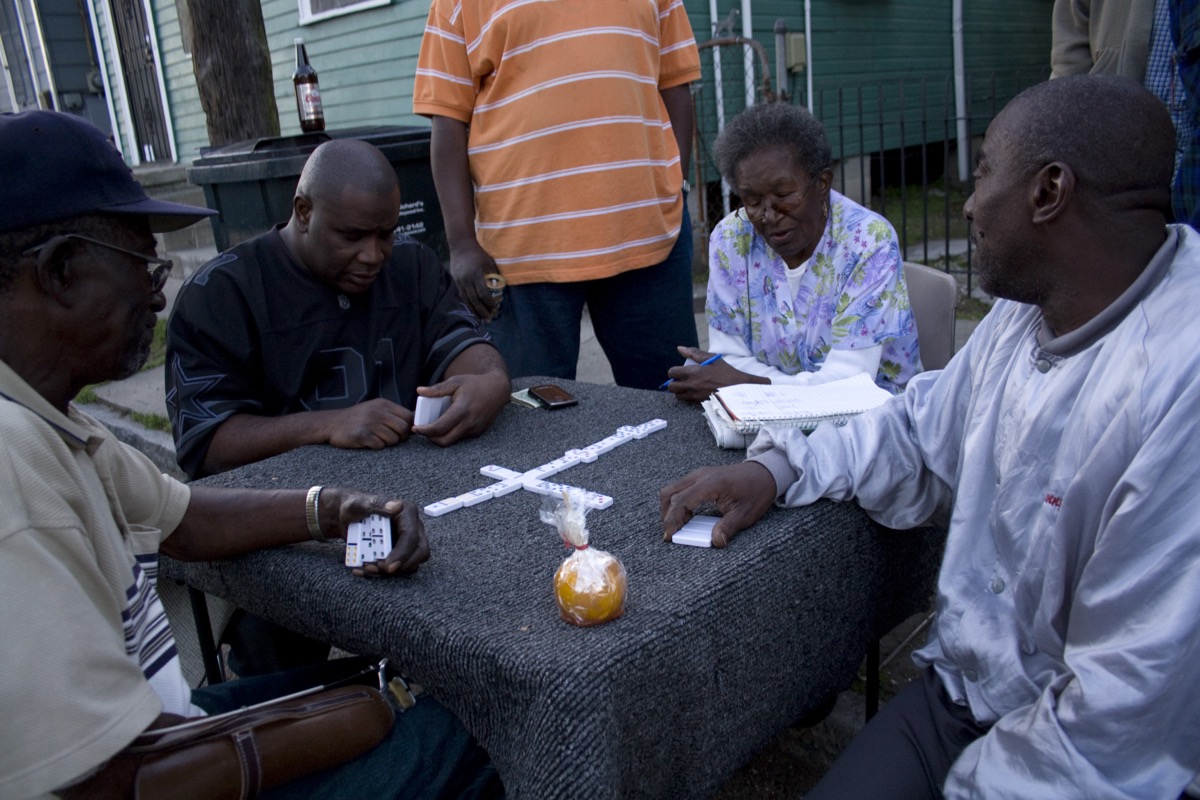
In the basic block and draw games a double is not a spinner. pagat.com says this explicitly for both games: doubles go across the line but you cannot build off their sides. Many other games do let the first double, or every double, branch in four directions (the Wikipedia article on dominoes calls this a spinner), and the line on the table in the photograph at the top of this page branches into a cross. If you are learning, start without spinners. One line with two ends is easier to read.
Doubles are also the tiles that strand players. A [6-3] can go on a 6 or on a 3; the [6-6] can only go on a 6. Late in a hand, a double whose suit has run out on the table cannot be played at all, and it is often among the heavier tiles in your hand.
Block or draw: when you cannot play
Every other rule is the same; this is the one that splits the game in two.
Block dominoes
If you cannot match an open end, you pass. The boneyard is never touched. The hand ends when someone plays their last tile or when nobody can play.
Draw dominoes
If you cannot play, you draw from the boneyard until you can. Under pagat.com's version the last two tiles are never drawn; once only two remain, a player with no match passes. You may also draw when you could play.
That last draw rule surprises people. pagat.com's main draw rules allow a player to draw even when holding a playable tile, hoping to find a tile that blocks the game and forces the next player to draw heavily. Other tables forbid drawing while you can play; pagat.com records that stricter rule as a variation too, along with limits of one or two draws per turn and versions that let you draw the boneyard down to nothing. Agree which one you are using before the deal.
Watch out for names as well. Wikipedia's description of the “blocking game” has players drawing until they can play, which pagat.com would call a draw game. When two rule sheets seem to disagree, check what each says happens when you cannot play. That tells you which game you are actually reading about.
Ending a hand and counting the pips
A hand ends in one of two ways. Either a player lays their last tile, which is called going out or “dominoing”, or the game blocks: nobody can match either end (and, in the draw game, the boneyard is down to its last two tiles).
Then everyone turns their remaining tiles face up and adds up the pips. A blank half is zero; the [6-5] is 11. The player with the lowest total wins the hand and, under pagat.com's rules, scores the sum of the other players' totals minus their own. A player who went out has zero, so they simply collect everyone else's pips. If two players tie for the lowest total, nobody scores. pagat.com plays to 100 points for two players or partnerships and 61 for three or four, a target that fits a cribbage board. Plenty of tables pick their own target; agree it up front.
That count-the-pips rule is all you need for block and draw. Games that score points during play, such as All Fives, work very differently, and scoring in other domino games is a subject of its own.
Two, three or four players
The rules do not change with the number of players, but the game does.
Two players. Seven tiles each and a 14-tile boneyard. Half the set is hidden, so in a block game neither of you can be sure the other is out of a suit. In a draw game the 12 drawable tiles make it hard to get stuck for long. Two-player tactics get their own treatment in how to play dominoes with 2 players.
Three players. The two games feel most different here. Block deals five each and leaves 13 tiles out of play, so passing is common. Draw deals seven each and leaves 7 in the boneyard, 5 of them drawable.
Four players. Five each in block, six each in draw. pagat.com notes the four-handed game can be played as individuals or as two partnerships, with the partnership game played to 100 points. The four-player game where all 28 tiles are dealt, seven each with no boneyard at all, is a different game in pagat.com's catalog (partnership dominoes), which it describes as popular in Spain and Latin America.
Watch an opening, move by move
The hands below are invented for teaching, not taken from a real game. It is a two-player block game on a double-six set, seven tiles each, with the highest double setting first. Step through it with the buttons; the line, the open ends and both hands update on every move. Watch move 12, where B has a choice that decides the score.
Illustrative opening · two-player block game
Move 1 of 13 (A): A holds the highest double, so A sets [6-6]. It sits across the line. Open ends: 6 and 6.
Player A: 6 tiles, 38 pips
Player B: 7 tiles, 39 pips
Beginner mistakes worth unlearning
- Holding the heavy tiles to the end. When a hand is lost, every pip you hold goes to the winner. Given a free choice between two playable tiles, getting rid of the heavier one is usually right. The sample opening shows the swing: the same hand is worth 0 or 8 points depending on one choice.
- Sitting on doubles. A double can only go on its own number. Play it while that number is still showing, before the suit runs out and the tile is stuck.
- Ignoring your strongest suit. pagat.com's strategy note for both games is to set your strongest suit, preferably with a double, and to keep that suit showing on the ends. If you hold four 5s, the more 5s on the table, the more turns you can play.
- Forgetting to count the table. Each number appears on seven tiles in a double-six set. When six of the 4s are on the table and none are in your hand, whoever holds the last one controls that end. Counting what has been played is the first real skill of the game.
- Not agreeing the house rules. Hand size, who leads, whether you can draw while you can play, and the target score all vary between tables. Settle them before the shuffle, not after the first argument.
After the basic game
Block and draw are the starting point for a large family. Muggins and All Fives score whenever the open ends add to a multiple of five; Mexican Train and Chicken Foot branch several lines off a central double; partnership games deal out the whole set. The catalog of domino games sorts them by how they play. If you just want to know what is in the box, how many dominoes are in a set covers every size from double-six up.
And if you like the matching but have no one to play with, the same tiles power a solo logic puzzle. In today's free pips game you place a tray of dominoes on a grid so every colored region meets its rule. The guide to playing Pips and the Pips rules explain how it differs from the table game, and games like Pips lists other tile puzzles.
Questions beginners ask
- Can you play a tile on the side of a double?
- Not in the basic block and draw games. pagat.com’s rules for both say doubles are played across the line but are not spinners, so a double still has only two playable ends. Games that branch from the sides of a double, such as All Fives, say so in their own rules.
- What happens if nobody can play?
- The hand is blocked and ends. Everyone counts the pips left in their hand, and the player with the lowest total wins the hand. If two players tie for lowest, nobody scores that hand under pagat.com’s rules.
- Are dominoes and the Pips puzzle the same game?
- No. Dominoes is a table game for two or more players who take turns matching ends. Pips is a one-player logic puzzle that uses domino tiles: you place a given set of tiles on a grid so that each colored region meets its rule. The tiles are shared; the rules are not.
Keep reading
- How to score dominoesBlock and draw pip counts, All Fives and Muggins ends, rounding to five, and a free scorer.
- Domino gamesTwelve domino games compared by players, set and objective, with a picker for the set you own.
- Mexican Train dominoes rulesThe deal for 2–10 players, the engine for all 13 rounds, markers, doubles, scoring and house variants.
- Pips on a dieA die has 21 pips and opposite faces add to 7 — right- vs left-handed dice, red Asian pips, and a counter for stacked or rolled dice.
Or go back to today's pips puzzle.