How Many Dominoes in a Set?
How many dominoes in a set depends on its highest double. A standard double-six set has 28 dominoes. A double-nine set has 55, a double-twelve 91, a double-fifteen 136 and a double-eighteen 190. Every size follows one formula: (n+1)(n+2) ÷ 2 tiles, where n is the most pips on one end of a tile.
The calculator below works out any set from double-3 to double-21 and shows how many tiles each player starts with in the common games for that set, taken from the rules on pagat.com. Further down: why the double-six number is 28 and not some rounder figure, how to check a secondhand box is complete, and which size to buy for the number of people at your table.

By Sukie · Puzzle editor
Domino set calculator
Pick a set and a table size. Counts are worked from the set's highest value; hand sizes come from the pagat.com rules for each game.
- Tiles in the set
- 28
- (6+1)(6+2) ÷ 2
- Doubles
- 7
- 0-0 through 6-6
- Non-doubles
- 21
- 6×(6+1) ÷ 2
- Total pips
- 168
- (6+2) × 6×(6+1) ÷ 2
- Tiles in each suit
- 7
- every value pairs with 0–6
- Halves showing each value
- 8
- the double counts twice
Starting hand with 4 players on a double-6 set
| Game | Tiles each | Dealt in total | Left in boneyard |
|---|---|---|---|
| Block | 5 | 20 | 8 |
| Draw | 6 | 24 | 4 |
| All Fives | 5 | 20 | 8 |
| Muggins / Fives and Threes | 5 | 20 | 8 |
| Texas 42four players only | 7 | 28 | 0 |
Why a double-six set has 28 tiles
A Western domino set contains every pairing of its values exactly once, and nothing else. In a double-six set the values run from 0 (the blank) to 6, which is seven values. Each tile is an unordered pair — 2-5 and 5-2 are the same piece — so the question is how many different pairs seven values can make, counting a value paired with itself as a double.
The easiest way to see the answer is to lay the set out by its higher end. There is one tile whose higher end is 0: the double blank. Two tiles have a higher end of 1: 1-0 and 1-1. Three have a higher end of 2, and so on, until the sixes row, which holds seven tiles from 6-0 to 6-6. The rows grow by one each time, so the set is a triangle, and its size is 1 + 2 + 3 + 4 + 5 + 6 + 7 = 28.
The same triangle gives the general formula. A set whose top value is n has n+1 values, so its rows hold 1, 2, … n+1 tiles, and the sum of the first n+1 whole numbers is (n+1)(n+2) ÷ 2. For double-six that is 7 × 8 ÷ 2 = 28. The triangle also splits the set into two kinds of piece: the doubles down the right edge, of which there are always n+1, and everything else, n(n+1) ÷ 2 tiles with two different ends. For double-six that is 7 doubles and 21 mixed tiles.
Read the triangle by column instead of by row and it shows the suits. A suit is every tile that carries a given value; the sixes suit is the bottom row, while the threes suit is the threes row plus the 4-3, 5-3 and 6-3 below it. Whichever way you trace it, each suit in a double-n set has n+1 tiles — seven in double-six — because a value pairs once with every value including itself. The double is the only tile that shows the value on both halves, so the value appears on n+2 halves in all: eight in a double-six set. That is where the set's total of 168 pips comes from, and the domino pips page goes through it suit by suit, along with blanks, spinners and scoring by pip count.
Every common set size, worked out
Pagat names five Western set sizes in its overview: double-six as the familiar default, double-nine, double-twelve (made popular by Mexican Train), and the double-fifteen and double-eighteen sets that “can also be found” for larger North American games. Its draw and block pages add a sixth, the double-eight set of 45 tiles used in Austria and Hungary. Every figure in the table below comes from the formulas above; the “used for” column names the games whose pagat rules call for that set. If a box is not labeled, find its biggest double: that one tile tells you how many the box should contain.
| Set | Tiles | Doubles | Tiles per suit | Total pips | Used for |
|---|---|---|---|---|---|
| Double-six | 28 | 7 | 7 | 168 | Block, Draw, All Fives, Muggins, Fives and Threes, Texas 42 |
| Double-nine | 55 | 10 | 10 | 495 | Chicken Foot; around since the early 20th century (pagat) |
| Double-twelve | 91 | 13 | 13 | 1,092 | Mexican Train; Chicken Foot for 4–8 players |
| Double-fifteen | 136 | 16 | 16 | 2,040 | Chicken Foot for 6–12 players (Puremco table) |
| Double-eighteen | 190 | 19 | 19 | 3,420 | Chicken Foot for 8–16 players (Puremco table) |
Two things stand out. First, the tile count grows with the square of the top value, not in step with it: adding three values to go from double-six to double-nine almost doubles the set, and going from double-twelve to double-eighteen roughly doubles it again. Second, the pip total grows even faster, with the cube. A double-six set carries 168 pips, a double-eighteen 3,420 — about twenty times as many on fewer than seven times the tiles. That matters for games that score leftover pips at the end of a hand: a stranded tile in a double-twelve game can cost up to 24 points, against 12 in a double-six game.
The calculator above goes to double-21 because the formula keeps working at any size: a double-21 set would hold 253 tiles and 5,313 pips. Past double-eighteen, though, none of the pagat games checked for this page deals from such a set, so the hand table there reads “rule varies” rather than inventing a number.
Chinese dominoes are a separate family and do not follow the formula. According to pagat, their ends run from 1 to 6, matching the throws of two dice, which gives 21 different tiles; eleven of them are duplicated, so a Chinese set has 32 tiles. If you are looking at a set with no blanks and red one and four pips, that is what you have.
Double 6 dominoes: checking the box is complete
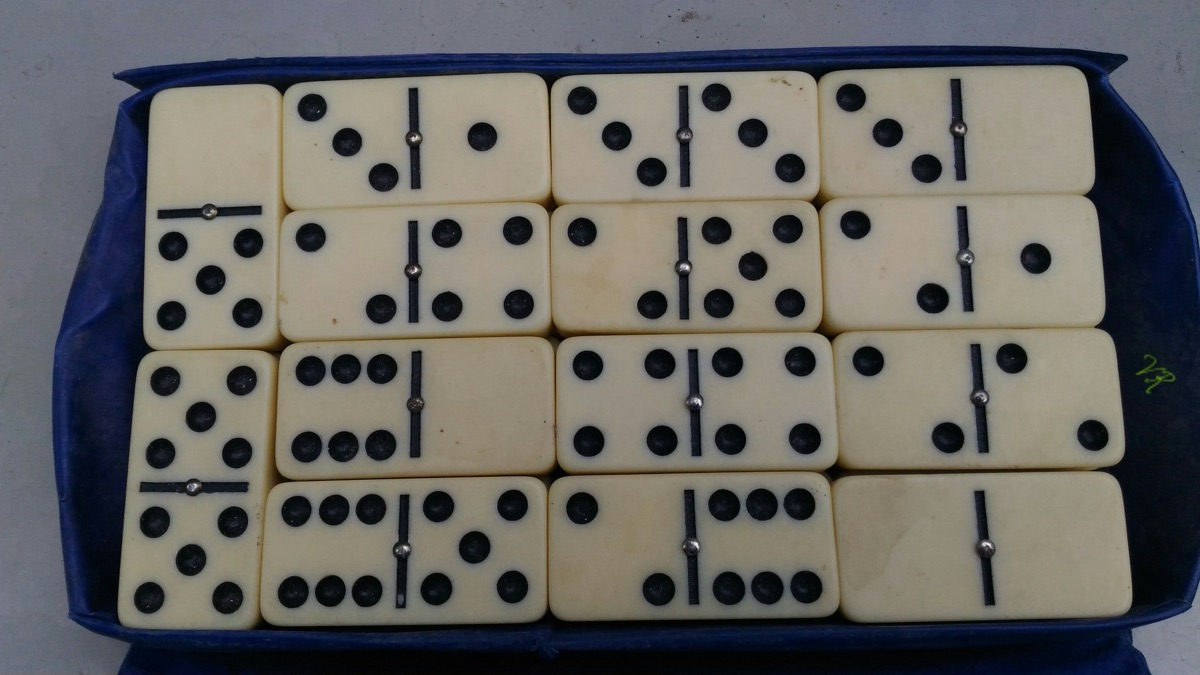
Double 6 dominoes are the set most people own, and a box bought secondhand or pulled out of a closet is often a tile or two short. Counting to 28 tells you something is missing but not what. Three quick checks narrow it down, and none of them needs the original packaging.
- Build the triangle. Lay the tiles out exactly as in the diagram above: the double blank on its own, then 1-0 and 1-1, then the three tiles topped by a two, down to the seven tiles topped by a six. A gap in a row is the missing tile, named by its row and position. This is the fastest method and it catches duplicates too, because a duplicate has nowhere to go.
- Count the doubles. There should be seven, from 0-0 to 6-6. If you have eight, you have mixed in a tile from another set — check whether the tile faces, colors and backs match.
- Count one suit. Every value should appear on exactly seven tiles. Pick the suit that looks thin, line up every tile carrying that value, and compare against the list 0, 1, 2, 3, 4, 5, 6 for the other end.
A pip total is a slower cross-check that works when you cannot sort the tiles, say a set in a sealed bag. A complete double-six set adds to 168; if the tiles you have add to 160, the missing tile carries 8 pips — 6-2, 5-3 or 4-4 — and a glance at the doubles settles which. Illustrative example: a box holds 27 tiles totalling 157 pips. The gap is 168 − 157 = 11, and the only double-six tile with 11 pips is the 6-5, so that is the one to look for under the sofa.
A box that is missing a tile still plays most games. In Block and Fives and Threes, pagat's deal leaves at least eight tiles out of play every hand, so one absent tile is just one more unseen piece. It only matters in Texas 42, where all 28 are dealt, and in games that count pips to settle a hand.
How many dominoes do you start with?
The set size says how many tiles exist; the game says how many each player draws. With a double-six set and two players, the answer in Block, Draw, Muggins and Fives and Threes is seven each. Three or four players usually take five, and All Fives deals nine each to two players. Bigger sets deal bigger hands. The table lists every deal used in this page's calculator, as printed on pagat.
| Game | Set | 2 players | 3 players | 4 players | More players |
|---|---|---|---|---|---|
| Block | Double-six | 7 | 5 | 5 | Not given |
| Draw | Double-six | 7 | 7 | 6 | Not given |
| All Fives | Double-six | 9 | 7 | 5 | 2–4 players only |
| Muggins | Double-six | 7 | 5 | 5 | 2–4 players only |
| Fives and Threes | Double-six | 7 | 5 | 5 | 2–4 players only |
| Texas 42 | Double-six | — | — | 7 | Four players only |
| Chicken Foot | Double-nine | 20 | 14 | 11 | 5 → 9, 6 → 7 |
| Mexican Train | Double-twelve | 15 | 15 | 15 | 5–6 → 12, 7–8 → 10, 9–10 → 8 |
| Chicken Foot | Double-twelve | — | — | 18 | 5 → 14, 6 → 12, 7 → 10, 8 → 9 |
Two odd-looking entries are reported as pagat lists them. Draw dominoes gives three players seven tiles each where Block gives them five; the other difference between the games is that in Draw a player who cannot move takes tiles from the boneyard instead of passing. Pagat does not explain the larger hand, so neither do we. Texas 42 deals all 28 tiles, seven to each of four partners, because it is a trick-taking game rather than a matching one: nothing is ever drawn.
House rules vary more than the table suggests. Pagat notes that South American players sometimes deal eight minus the number of players — six each for two, five for three, four for four — and that some Chicken Foot players prefer smaller hands from a double-nine set: twelve each for two, eleven for three, ten for four. When people at the table disagree, the deal is the first thing to settle, because it changes how long a hand lasts and how much luck is in the boneyard.
Once the tiles are dealt, how to play dominoes walks through the first move, matching ends and what to do when you are blocked.
Which set size fits your table
The deal tables answer the buying question too. A set suits a group when every player can take a full hand and a reasonable boneyard is left over. Working through the pagat deals:
- Two to four players: double-six. Five of the six double-six games in the table deal for two, three or four; Texas 42 needs exactly four. Four players in Block take 20 of the 28 tiles and leave 8 aside; two players take 14 and leave 14.
- Four to six players: double-nine. Chicken Foot's table deals 11 each to four (44 of 55, 11 left) and 7 each to six (42 dealt, 13 left). Pagat says the game seems best with four or more.
- Four to ten players: double-twelve. Mexican Train deals 15 each up to four players, then 12, 10 and 8 as the table grows. Eight players take 80 of the 91 tiles and leave 11. Pagat calls it probably best for four or more.
- Larger groups: double-fifteen or double-eighteen. The Puremco table extends Chicken Foot to twelve players on a double-fifteen (9 each, 108 of 136) and to sixteen on a double-eighteen (9 each, 144 of 190).
A rough rule falls out of the numbers: at each game's largest player count, these deals hand out between about 70 and 90 percent of the set (Texas 42, which deals all 28, is the exception). If the calculator shows that your group would need more than that, step up a size. The opposite mistake is less obvious — two players dealing 15 each from a double-twelve leaves 61 tiles in the boneyard, and a game where most of the set is never seen leans heavily on luck.
For what each of these games plays like, see the guide to domino games.
Scoring changes with set size as well; how to score dominoes covers counting hands and the fives family.
From a full set to a puzzle tray
Domino logic puzzles use the same double-six set but only a slice of it. The free daily pips puzzle on this site hands you a tray of tiles drawn from the 28, never more than one of each, and a grid of colored regions that tell you what the pips inside must add up to or match. Knowing the set helps more than you might expect: if a tray holds the 6-6, there is no second one, and if a region needs a double, there are only seven candidates in the whole set. The how-to-play guide explains the region badges, and what are pips covers the word itself, on dominoes, dice and playing cards. For the name of the dot itself, see what the dot on a domino is called.
Other set questions
- How many dominoes are in a double-nine set?
- Fifty-five. The highest value is 9, so the formula gives (9+1)(9+2)/2 = 55 tiles: ten doubles from 0-0 to 9-9 and 45 tiles with two different ends. Each suit holds ten tiles, and the set carries 495 pips in total.
- How many doubles are in a domino set?
- One more than the highest value: seven in a double-six set (0-0 to 6-6), ten in a double-nine, thirteen in a double-twelve, sixteen in a double-fifteen and nineteen in a double-eighteen.
- Why does Mexican Train use a double-twelve set?
- Partly for size — pagat’s deal lets up to ten players take a hand from its 91 tiles — and partly for the round structure. The first round opens with the 12-12, the next with the 11-11 and so on down to the double blank, which makes thirteen rounds: exactly the number of doubles in the set.
Keep reading
- How to play dominoesSetup, hand sizes for 2–4 players, matching ends, doubles, block vs draw, and counting pips — with a starting-hand helper.
- Dominoes with 2 playersSeven tiles each, Block vs Draw, scoring to 100, and a tile tracker for what your opponent can hold.
- How to score dominoesBlock and draw pip counts, All Fives and Muggins ends, rounding to five, and a free scorer.
- Domino gamesTwelve domino games compared by players, set and objective, with a picker for the set you own.
Or go back to today's pips puzzle.