Dot on a Domino: What It Is Called
A dot on a domino is called a pip (plural pips). The informal words are spot and dot, and all three name the same mark. Each half of a standard tile shows 0 to 6 pips, and a half with none is called a blank. In a crossword, a three-letter answer is almost always PIP and a plural four-letter answer is PIPS.
Most people who ask are either stuck on a clue or want the word for a conversation. The first section below handles the crossword case with a matcher you can type into. The rest covers how the dots are laid out, why there are three names for one thing, and how to count them on a tile.

By Sukie · Puzzle editor
The crossword answer, by letter count
Crossword clues about domino dots draw on a small vocabulary. The Wikipedia article on dominoes describes each end of a tile as “marked with a number of spots (also called pips or dots)”, and Wiktionary lists spot as the synonym of pip for a symbol on a card, domino or die. So the answer is one of three words, in the singular or the plural. Sorted by the number of squares in the grid:
| Squares | Candidate answers | Try first when |
|---|---|---|
| 3 | PIP, DOT | The clue is singular. PIP is the usual fill; DOT fits when the clue says “spot”. |
| 4 | PIPS, SPOT, DOTS | A plural clue points to PIPS or DOTS; a singular clue with four squares points to SPOT. |
| 5 | SPOTS | Only a plural clue fits five squares. |
Clue matcher
Type one character per square: a letter you know, or ? for a blank. For example P?P or ??OT. Leave it empty to see every word of that length.
- PIPThe standard term, singular. Fits a clue that names one dot: "dot on a domino", "spot on a die", "domino dot".
- DOTPlain-English singular. Possible when the clue avoids the word "dot" itself, e.g. "spot on a domino".
Reading the wording of the clue
Two things in the clue narrow the answer before you count squares. The first is number. “Dot on a domino”, “domino dot” and “spot on a die” name a single mark, so the answer is singular: PIP, DOT or SPOT. Phrases like “domino dots”, “dots on dominoes” or “black dots on dominoes” are plural, and so is the answer: PIPS, DOTS or SPOTS. The clue and the answer normally agree in number, so that is a free hint.
The second is which word the clue already uses. A clue that says “dot” is unlikely to want DOT back, so with three squares PIP is the strong favorite. A clue that says “spot” makes DOT a real option alongside PIP, and crossing letters settle it: a P in the first square means PIP, a D means DOT. Clues that mention a die, dice or a playing card as well as a domino still want the same words, because pip covers all three objects.
If none of the six words fits your crossing letters, the clue is probably not about the dot at all. Domino clues also ask for the tile itself (TILE, BONE), a whole game, or a number on a tile. The matcher above says so when nothing matches rather than guessing.
What the dots look like: seven layouts
A standard double-six domino is split by a center line into two square halves, and each half shows one of seven values: 0, 1, 2, 3, 4, 5 or 6. The dots are not scattered. According to Wikipedia's dominoes article, the spots from one to six “are generally arranged as they are on six-sided dice”, so a player who knows a die already knows every domino half. The diagram below draws the seven layouts on a three-by-three grid of positions.
Three details in those layouts are worth knowing. The center position is used only by the odd values: 1, 3 and 5 have a center dot, while 2, 4 and 6 do not. That is a fast way to tell a 5 from a 4 or a 6 at a glance without counting. Second, 2 and 3 share a diagonal, and the 3 is just the 2 with the center filled in. Third, the 6 is the only layout that uses the middle of the left and right edges, which is why it reads as two columns rather than a cluster.
The blank is a real value, not a missing one. A blank half is worth zero, it belongs to its own suit of blanks, and the double blank is a genuine tile of the set. On the 28-tile double-six set, the seven layouts above are the whole alphabet: every tile is two of them side by side.
On a real set
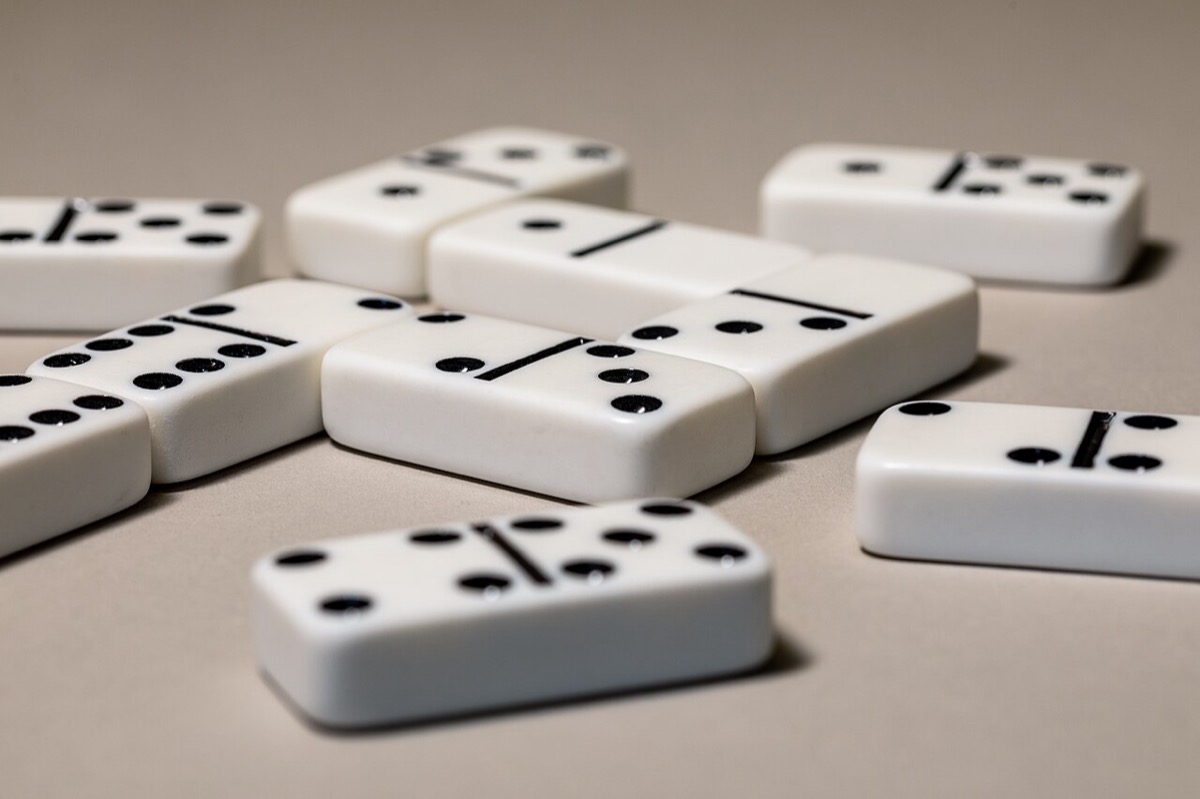

In the photo, every tile has a black center line, and the pips are small round black dots that appear set into the surface. That is the look most people picture, and it is where the plural clue “black dots on dominoes” comes from. It is not the only style. Wikipedia notes that traditional European sets were made of bone, ivory or dark hardwood such as ebony with “contrasting black or white pips which may be inlaid or painted”, so an ebony set has white dots on black tiles. It also notes that modern sets “commonly use a different color for the dots of each different end value”, which makes the layouts even faster to read across a table.
The back of a tile carries no pips. The backs in a set are indistinguishable, either plain or sharing a common design, which is what lets a hand be drawn face down. If you are looking at a tile with no dots on either side of the line, it is the face of the double blank, not the back.
Pip, spot or dot: which word is right
All three are correct, and they are not regional variants of each other. They sit at different levels of formality. Pip is the term of art: it is the word used for the marks on dice and playing cards as well as dominoes, and it is the word a rulebook uses when it tells you to count a hand. Spot is the everyday word for the same mark, and Wikipedia lists it first, with pip and dot as alternatives. Dot is plain description, which is why it is what most people type into a search box.
Where the word pip itself comes from is not settled. Wiktionary records the origin of this sense as uncertain. The domino sense is shared with dice and cards, and the same tiles are also known as bones, cards, men or pieces, so the vocabulary around the game has always been loose. What has stayed fixed is the meaning: one pip is one unit of value.
The word now has a second life as the name of a puzzle. The New York Times' daily domino-logic game is called Pips, and the free pips game on this site works the same way: you place dominoes so that the pips inside each region meet that region's rule. So a search for “pips” can mean the dots, the NYT game or a free version of it, depending on who is asking.
Counting the dots on a tile
The value of a whole tile is the sum of its two halves. A tile showing 2 on one side and 5 on the other is a 2-5 and carries 7 pips. A double carries the same number on both halves, so a 4-4 has 8 pips. On a double-six set the range runs from 0 pips on the double blank to 12 on the double six.
Across the whole set the arithmetic is tidy. A double-six set has 28 tiles, which is every pairing of the values 0 to 6 with repeats allowed: (6+1)(6+2)/2 = 28. Each value appears on eight tile halves (seven tiles, with the double counting twice), so the total dot count is 8 × (0+1+2+3+4+5+6) = 8 × 21 = 168 pips.
The tile counts for larger sets, and why the formula works, are worked through on how many dominoes are in a set.
Illustrative worked example: counting a hand
Suppose a round ends and a player is left holding three tiles: 6-3, 2-0 and 5-5. Count each tile by its halves: 6 + 3 = 9, 2 + 0 = 2, 5 + 5 = 10. The hand holds 9 + 2 + 10 = 21 pips. In block and draw games that end-of-hand pip count is what gets scored, as described on pagat.com's domino rules. The blank half added nothing, which is why a tile like 2-0 is a cheap one to be caught holding.
For the full scoring rules, including games that score open ends in multiples of five, see how to score dominoes.
Why this page is separate from “what are pips”
Two questions look alike and are not. Someone searching for a dot on a domino already has the object in front of them and wants a name for it, very often to fill a crossword grid. That is a short answer plus the crossword detail above. Our page what are pips starts from the other end: it takes the word and explains it across every object that uses it, including dice (21 pips on a standard die) and playing cards (where the pips are the suit symbols), as well as what the word means in the puzzle.
A third page goes deeper into the tiles alone. Domino pips covers the seven suits of the double-six set, what a blank is worth in different games, doubles and the spinner, and scoring a hand by pip count. If you came here for a crossword, you are done; if the word sent you down a rabbit hole about the tiles, that is the next stop.
Where the dots do the work: the pips puzzle
In a pips puzzle the dots stop being decoration and become the numbers you reason with. The board is split into colored regions, each with a condition on the pips that land inside it: an exact total, all values equal, all values different, or a comparison such as “less than 4”. You have a fixed tray of dominoes and must cover the grid so every condition holds.
Reading layouts quickly pays off here. A region marked “0” can only take blanks. A region of three squares that must total 18 can only take three sixes, and there are only seven sixes in the whole double-six set. Knowing the shapes in the diagram above lets you scan the tray by pattern instead of counting dots one at a time. The how to play pips guide walks through a first board, and the full pips rules list every region type.
Short answers
- What is a dot on a domino called?
- A pip. Each end of a domino is marked with a number of spots, also called pips or dots, or is left blank. Pip is the term rulebooks and dictionaries use; spot and dot are the everyday words for the same mark.
- What is the crossword answer for "dot on a domino"?
- PIP if the grid gives three squares. A plural clue such as "domino dots" usually wants PIPS (four). If the letters you have rule those out, try SPOT, DOT, DOTS or SPOTS, which are the other names for the same mark.
- How many dots are on a domino?
- It depends on the tile. Each half carries 0 to 6 dots on a standard set, so a single tile has anywhere from 0 (the double blank) to 12 (the double six). A full double-six set of 28 tiles carries 168 dots in total.
Keep reading
- Pips rulesEvery region badge, what it demands, and the order to solve in.
- How to play pipsA first board walked through one move at a time.
- The ≠ ruleWhy "not equal" constrains values, not dominoes.
- Hardest pips puzzlesWhat actually makes a board brutal, and how to attack one.
Or go back to today's pips puzzle.