Pips on a Die: How Many, and Where They Go
Pips on a die are the dots that mark each face, and a standard six-sided die has 21 of them (1 + 2 + 3 + 4 + 5 + 6). Opposite faces always add up to 7: 1 is opposite 6, 2 is opposite 5, and 3 is opposite 4. So two dice carry 42 pips, three carry 63, and the face hidden under any die is 7 minus the face on top.
That is the whole answer for most people. The rest of this page is for the follow-up questions: how to count pips you cannot see on a stack or a roll, why there are exactly two ways to build a die that obeys the seven rule (and which countries use which), why some dice paint the 1 and 4 red, and what changes on a d8 or a d20. Every fact is checked against Wikipedia's Dice article and Wolfram MathWorld, and every number below that is not quoted from them is arithmetic you can redo.

By Sukie · Puzzle editor
Count the pips on any number of dice
Pick how many dice you have and which face is up. The counter gives the total, the face underneath, and how many pips are visible or hidden when the dice are stacked in a tower. The roll button checks the bottoms-of-a-roll trick explained further down.
Dice pip counter
Face showing on top (of the top die, if they are stacked)
- Total pips on 2 dice
- 42
- 21 × 2
- Face underneath a 1
- 6
- 7 − 1, the opposite face
- Stack of 2: pips you can see walking round it
- 29
- 14 × 2 side pips + 1 on top
- Pips hidden underneath and between the dice
- 13
- 7 × 2 − 1
Roll to see the top faces and work out the hidden bottoms without turning anything over.
21 per die: totals for 1 to 6 dice
A common die is numbered one to six, and each face shows its number as that many pips. Adding the faces gives 1 + 2 + 3 + 4 + 5 + 6 = 21. There is a quicker way to see it that also explains the seven rule: the six faces form three opposite pairs, each pair adds to 7, and 3 × 7 = 21. Every standard die carries the same 21, so the total for a handful of dice is just 21 times the count.
| Dice | Total pips | Average total showing on a roll |
|---|---|---|
| 1 | 21 | 3.5 |
| 2 | 42 | 7 |
| 3 | 63 | 10.5 |
| 4 | 84 | 14 |
| 5 | 105 | 17.5 |
| 6 | 126 | 21 |
People who search for “21 pips meaning” usually met the number in one of two places: a riddle about a die, or a game rule that counts pips. In both cases it is this sum. A standard six-sided die has no blank face, which is the first real difference from a domino: a domino half can carry zero pips, while a die starts at one.
Why opposite faces add up to 7
Wikipedia puts the convention plainly: “Opposite sides of a modern die traditionally add up to seven, requiring the one, two, and three faces to share a vertex.” MathWorld says the same: on the six-sided die, opposite faces “are arranged to always sum to seven”. The convention is old. Wikipedia notes that the terracotta dice excavated at Mohenjo-daro, dated 2500–1900 BCE, include at least one whose opposite sides all add up to seven, as on modern dice.
The second half of that quote is a neat consequence. If 1 faces 6, 2 faces 5 and 3 faces 4, then 1, 2 and 3 can never be on opposite sides of each other, so all three must meet at a single corner. The same goes for 4, 5 and 6 at the diagonally opposite corner. Unfold the cube and the rule is easy to check by eye:
Right-handed (usual Western die)
3 sits left of the 1. Seen from outside, the 1-2-3 corner turns counterclockwise.
Left-handed (usual Chinese die, red 1 and 4)
3 sits right of the 1. The same corner turns clockwise: the mirror image.
- 1 + 6 = 7
- 2 + 5 = 7
- 3 + 4 = 7
Right-handed and left-handed dice
Once the opposite pairs are fixed, there are exactly two different dice you can make, and they are mirror images. Here is why. Put the 1 on top, which forces the 6 to the bottom. Turn the die until the 2 faces you, which forces the 5 to the back. Only the left and right faces remain, and they must hold the 3 and the 4. The 3 goes either on the left or on the right. That single choice is the only freedom left, so there are two dice, and MathWorld confirms the count: the sum-to-seven rule “gives two possible mirror image arrangements”.
The names come from the corner where 1, 2 and 3 meet. In Wikipedia's words, “If the one, two, and three faces run counterclockwise, the die is called ‘right-handed’. If those faces run clockwise, the die is called ‘left-handed’.” The same article adds that “Western dice are normally right-handed, and Chinese dice are normally left-handed.” MathWorld is more cautious about real products, noting that commercial dice “may, in fact, have either orientation”, so check a die before assuming.
A quick test with the die in your hand: turn it so 1 faces you and 2 is on top. If the 3 is on your left, the die is right-handed; if it is on your right, it is left-handed. That matches the two nets above, where the centre square is the face towards you.
Counting pips you can't see
The seven rule turns several puzzle-book questions into one-line sums. Three results do most of the work, and the counter above uses all of them.
- The four side faces of a die always total 14. The sides are two opposite pairs, and each pair adds to 7. It does not matter which face is up.
- A die on a table shows 14 + (top face) as you walk round it. Only the bottom is hidden, and it is 7 minus the top. With a 5 on top you see 14 + 5 = 19 pips and the hidden 2 makes the total up to 21.
- A tower of n dice with t on top shows 14n + t and hides 7n − t. Each die contributes its 14 side pips. Between two dice, the top of the lower one and the bottom of the upper one are pressed together and hidden, and the very bottom face rests on the table. Every die therefore hides one complete opposite pair (7 pips), except that the top die shows its upper face.
Illustrative worked example: a tower of three dice
Stack three dice with a 4 showing on top. The three dice carry 3 × 21 = 63 pips. Walking round the tower you can see 14 × 3 = 42 side pips plus the 4 on top, so 46 are visible. The hidden pips are 7 × 3 − 4 = 17, and 46 + 17 = 63 checks out. You did not need to know how any die was turned, which is the point of the puzzle.
The bottoms of a roll
The same idea works on a throw. Roll n dice and add the faces that land up; call it S. The faces against the table are each 7 minus their top, so they add to 7n − S. Roll two dice for an 8 and the bottoms show 14 − 8 = 6. Roll five for a 17 and the bottoms show 35 − 17 = 18. Top plus bottom is always seven per die, which is why a pair of dice can never hide anything but 14 − (what you see). Press Roll in the counter to try it.
One caution if you are checking a puzzle answer: these formulas assume you can see all four sides. If you look at a tower from one side only, the faces you see depend on how each die was turned, and there is no fixed answer without more information.
How the pips are laid out and made
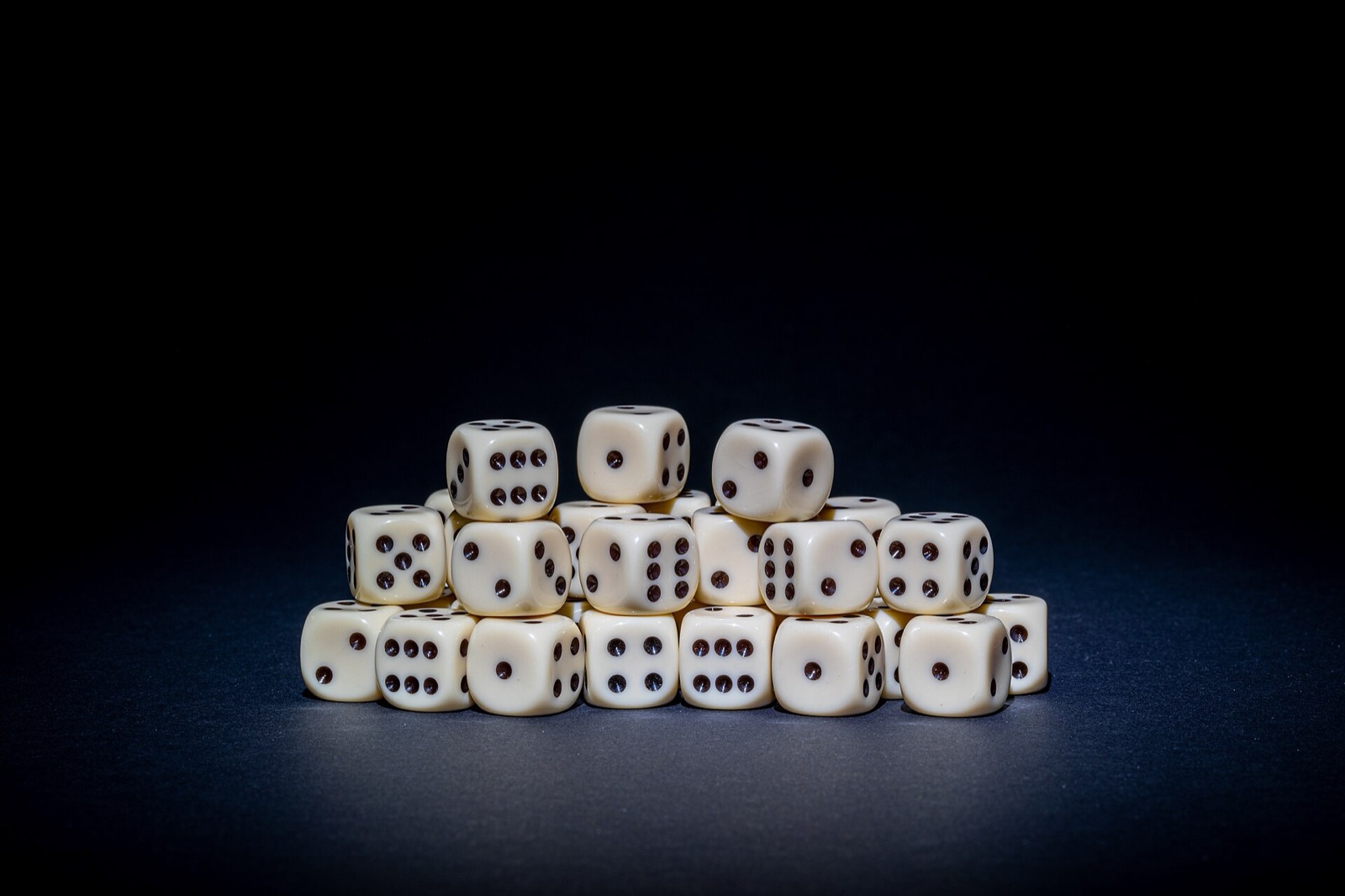

The dots sit on an invisible three-by-three grid. The 1 is a single centre pip. The 2 and 3 run along a diagonal, with the 3 adding the centre. The 4 fills the corners and the 5 is the 4 plus the centre. The 6 is two rows of three. Only the odd faces use the centre, which is the fastest way to tell a 5 from a 4 or a 6 without counting.
Look closely at the photo and you will see that the sixes do not all point the same way: some run as two columns, others as two rows. The 2, 3 and 6 patterns change when you give the die a quarter turn, while the 1, 4 and 5 look the same in every orientation, so the same face can look different from one die to the next without being a different value.
On cheap dice the pips are moulded or printed. On casino dice they are an engineering problem, because drilling out more material from the 6 face than from the 1 would make the cube lighter on one side. Wikipedia describes precision dice as having “pips drilled 17 ± 4 mils (0.43 ± 0.10 mm) deep and filled with opaque paint or epoxy that matches the density of cellulose, ensuring the dice remain balanced.” Precision dice are the ones used in casinos; the same article calls the dice sold with board games “drugstore” or non-precision dice.
Red ones and fours on Asian dice
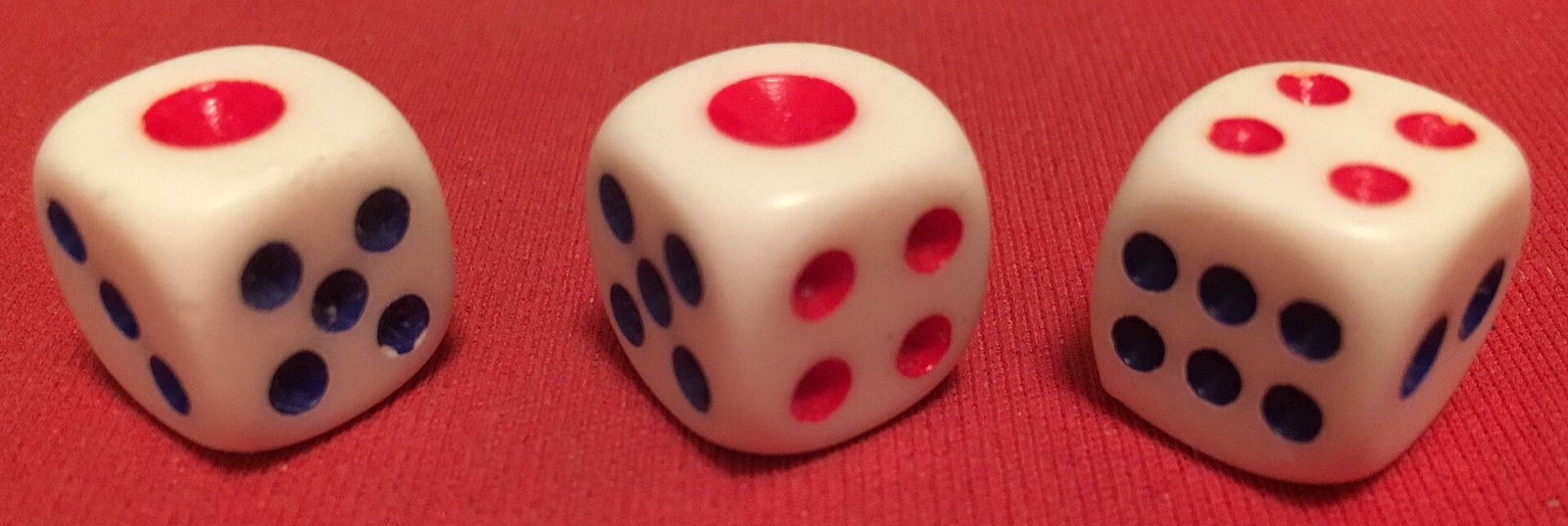

Dice from China and neighbouring countries use the same seven rule and the same layouts, with two visible differences. According to Wikipedia's Dice article, “the pips are differently sized on Asian style dice, and the pips are colored red on the one and four sides”, and “the red fours may be of Indian origin.” The Wikipedia article on pips adds that Asian dice often have an enlarged red single pip on the one face, which is exactly what the two left-hand dice in the photo show.
The third difference is invisible until you look at a corner. As covered above, Chinese dice are normally left-handed, so the 1, 2 and 3 run clockwise around their shared corner. The pip totals do not change: a red-pipped die still carries 21 pips and still hides 7 minus whatever is on top. The colour is a convention about appearance, not value.
What about d4, d8, d10, d12 and d20?
Role-playing dice follow a generalised version of the seven rule. Wikipedia states that “normally, the faces on a die are placed so that opposite faces add up to one more than the number of faces”, and that this is not possible on four-sided dice or dice with an odd number of faces. The table applies that to the common set; the totals in the third column are simple sums of each die's face values.
| Die | Faces | Sum of all faces | Opposite faces add to |
|---|---|---|---|
| d4 | 1–4 | 10 | No opposite faces (a vertex faces each face) |
| d6 | 1–6 | 21 | 7 |
| d8 | 1–8 | 36 | Usually 9 |
| d10 | 0–9 | 45 | Sequential numbering from 0; the 0 may read as 10 |
| d12 | 1–12 | 78 | Usually 13 |
| d20 | 1–20 | 210 | 21 |
Strictly, those numbers are face values rather than pips. Wikipedia notes that dice may carry numerals or symbols instead of pips, and the role-playing set in the table is numbered: a d20 marked with 210 dots would be hard to read at a glance. The d6 is the die where pips and numbers are the same thing, which is why “pips on a die” nearly always means the six-sided cube.
Pip, spot, die, dice: the words
Pip is the standard name: Wikipedia's Dice article describes faces numbered “by patterns of round dots called pips”. Wiktionary defines this sense as “one of the spots or symbols on a playing card, domino, die, etc.” and records its origin as uncertain, so any confident story about where the word came from is a guess. Spot is the plain-English alternative and the word MathWorld uses; dot is the everyday word.
Die is the singular and dice the plural, so “pips on a die” and “pips on dice” are the same question in two grammatical numbers. Wikipedia traces die to the Old French dé, from the Latin datum, “something which is given or played”.
The same pips on dominoes and cards
Dice lent their layouts to dominoes. The Wikipedia article on dominoes says the spots from one to six on a tile “are generally arranged as they are on six-sided dice”, with a blank added for zero. That is why a double-six domino set has 28 tiles and 168 pips, which is 8 × 21: each value from 0 to 6 appears on eight tile halves. The derivation is on how many dominoes are in a set, and the domino side of the vocabulary is on domino pips and what a dot on a domino is called.
On playing cards the pips are the suit symbols printed on the number cards. For the word across all three objects, see what are pips. And if you want the dots to do some work, the daily pips puzzle on our homepage asks you to place dominoes so the pips in each region hit a target; the pips rules explain every region type.
Quick questions about dice pips
- How many pips are on a die?
- A standard six-sided die has 21 pips: 1 + 2 + 3 + 4 + 5 + 6. Two dice have 42, three have 63 and five have 105, because every die carries the same 21.
- What are the dots on dice called?
- Pips. Wikipedia describes common dice as cubes whose faces are numbered one to six "usually by patterns of round dots called pips", and MathWorld calls the same marks spots. Pip, spot and dot all name the one mark.
- Do opposite sides of a die always add up to 7?
- On a standard modern die, yes: 1 is opposite 6, 2 opposite 5 and 3 opposite 4. Wikipedia says opposite sides "traditionally add up to seven". Novelty and very old dice can break the rule, so treat it as the convention, not a law.
- What does 21 pips mean?
- It is the pip total of one six-sided die, the sum of the numbers 1 to 6, or three opposite pairs of 7. A riddle or game rule that mentions 21 pips is almost always counting one complete die.
- Why are the 1 and 4 red on some dice?
- That is the Asian style. Wikipedia notes that on Asian-style dice the pips are differently sized and are colored red on the one and four sides, and that the red fours may be of Indian origin.
Keep reading
- How to play NYT PipsThe rules, and what measuring every published board says about the difficulties.
- Games like pipsHonest comparisons with the puzzles pips players move on to.
- Printable pips puzzlesBoards laid out for paper, with a print sheet you can run off.
- NYT Pips hardEvery hard board measured: size, who builds them, the extremes, and how to beat one.
Or go back to today's pips puzzle.