Playing Card Pips: What They Are and Where Each One Goes
Playing card pips are the suit symbols that mark a card's value on the number cards. The 7 of hearts shows seven heart pips, the 10 of spades ten spade pips, and the ace a single pip. Jacks, queens and kings carry a picture instead of a pip layout, and the small symbols in the corners are an index, not pips.
The arrangement is fixed. Any 8 you pick up has its pips in the same places, and that pattern has barely changed since the 1870s. Below you can open any card in a viewer, see all nine layouts from 2 to 10 side by side, and find out why the bottom pips are printed upside down. There is also a full count for the 52-card pack and for the shorter packs used in Europe.

By Sukie · Puzzle editor
Open any card and count its pips
Pick a rank and a suit. The viewer draws the card in the standard Anglo-American layout and gives the pip count, how many pips point up and down, the card's pip value in cribbage, and how far it takes you towards the 55 pips in one suit. Turn on the outline to see which marks are the corner index, the part people most often count by mistake.
Pip layout viewer
Seven of hearts: 7 pips
The six plus one centre pip placed between the top and middle rows.
- Pointing up / down
- 5 / 2
- Cribbage pip value
- 7
- Pips in this suit, ace up to this card
- 28 of 55
Ace to ten: the standard layout, rank by rank
Wikipedia's article on pips says the number of pips “corresponds with the number of the card” and that their arrangement “is generally the same from deck to deck”. It does not show you that arrangement. Here it is for the nine numbered cards.
2 · 1 up, 1 down
3 · 2 up, 1 down
4 · 2 up, 2 down
5 · 3 up, 2 down
6 · 4 up, 2 down
7 · 5 up, 2 down
8 · 5 up, 3 down
9 · 5 up, 4 down
10 · 5 up, 5 down

Three columns and a handful of rows do all the work. The 2 and 3 use only the centre column, and the 3 is the 2 with a pip added in the middle. The 4 moves everything to the corners and the 5 puts a pip back in the centre, which is the same pattern as the five on a die. From the 6 upwards the side columns carry most of the pips. The 6 has three on each side, the 7 and 8 add centre pips to that, and the 9 and 10 have four on each side.
Two details trip people up. On the 7 the extra pip sits in the upper half, between the top and middle rows, not in the dead centre. On the 9 the single centre pip sits exactly on the middle line. Bostock notes that early French cards put the 9's centre pip in the middle too, which he calls “perhaps not the most obvious choice”. Modern cards still do it, and a pip sitting right on the middle line is a quick way to tell a 9 from a 10 when only the centre of the card is showing.
| Card | Pips | Layout | Up / down |
|---|---|---|---|
| Ace | 1 | One pip, centre, often enlarged | 1 / 0 |
| Two | 2 | Centre column: top, bottom | 1 / 1 |
| Three | 3 | Centre column: top, middle, bottom | 2 / 1 |
| Four | 4 | The four corners | 2 / 2 |
| Five | 5 | Four corners + centre | 3 / 2 |
| Six | 6 | Two side columns of three | 4 / 2 |
| Seven | 7 | Six + one centre pip, upper half | 5 / 2 |
| Eight | 8 | Six + two centre pips | 5 / 3 |
| Nine | 9 | Two side columns of four + centre | 5 / 4 |
| Ten | 10 | Two side columns of four + two centre | 5 / 5 |

Why the bottom pips are printed upside down
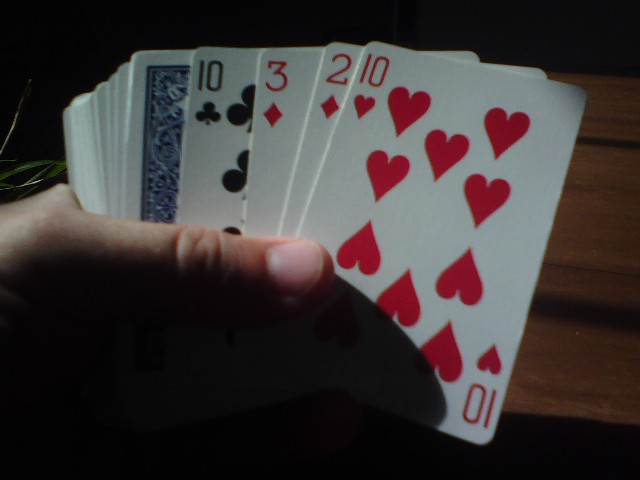
Look at the 10 of hearts in the photo and the hearts in the lower half are inverted. That is because modern cards are double-ended: they are designed to look right whichever way up you hold them. Wikipedia's standard 52-card deck article dates double-headed English cards to around 1860. Before that, every card had one correct way up.
The pips went through several experiments on the way, and the collector Paul Bostock classified them after going through about 400 standard packs for The World of Playing Cards. The main stages, in his order:
- All pips one way. A French pack by Jean Gisaine from about 1745 has every pip facing the same direction, like its full-length court figures. English cards by Henry Hart from about 1770 do the same, with the centre pips pushed towards the card edge. Bostock describes that as the typical English layout until double-ended cards arrived.
- Symmetrical pips. The first English double-ended cards, by Ludlow and Wheeler around 1801, and an American pack by J. Y. Humphreys around 1816 made the even cards look the same turned round and the odd cards nearly so. Bostock's verdict is that the mix of directions at the top of each card “fails aesthetically”.
- Four up, three down. Thomas Crehore's cards from about 1820 put the emphasis on having the top pips all point the same way. His 7 has four pips up and three down, and other American makers soon copied it.
- Five up, two down. De La Rue cards from about 1870 have the 7 with five pips up and two down and the 8 with five up and three down. Bostock calls this “more-or-less the modern standard”. The English did not fully switch to double-ended designs until the 1870s.
That last stage is the one in the diagram above. On the 7 and 8 the extra centre pips sit in the upper half, so the card has more pips pointing up than down. Bostock suggests that is why it won: having more pips aligned gives the card “an obvious preferred orientation”. Diamonds are a special case. A diamond looks the same either way up, so as Bostock puts it, a diamond card “can always be interpreted either way”.
Having a top and a bottom also matters at the table. Bostock notes that bridge partners can use a card's orientation as a signal, for instance agreeing that a card played upside down asks for a change of suit. To prevent that, Piatnik and Cartamundi have made fully symmetrical cards for bridge. They never caught on, partly because players found the aces hard to tell apart in poor light.
Pips are not the corner index
Every modern card also carries its rank and a small suit symbol near the corners. That is the index, and it is not part of the pip count. A 7 of hearts has seven pips. It does not have nine, even though two more small hearts are printed by the 7s in the corners. The index exists so you can identify a card when only its corner shows, in a fanned hand or a spread on the table.
Indices arrived long after pips. Wikipedia's playing card article records a Latin-suited pack with edge indices printed by Infirerra and dated 1693, but says the idea only came into common use from the end of the 18th century. The first American-made deck with indices was Saladee's Patent, printed by Samuel Hart in 1864. In 1870 Hart and his cousins at Lawrence & Cohen brought out the Squeezers, the first indexed cards to sell widely. On the English pattern, corner indices were added around 1880.
Most packs print the index in two opposite corners, top left and bottom right. The pip article notes that four-corner indices are more common in Europe and suit left-handed players, who fan their cards the other way. On the ace and the court cards, the index shows a letter instead of a number: A, K, Q and J in English-speaking countries, A, K, D and B in Germany, and 1, R, D and V in France.
Court cards cause the same confusion. In the standard pack each jack, queen and king is drawn with a symbol of its suit, but that symbol labels the suit and does not count anything. A king of hearts is not a one-pip card. Pip cards and court cards are kept apart for exactly this reason: one is counted and the other is a picture.
The ace: one pip, and on spades a very large one
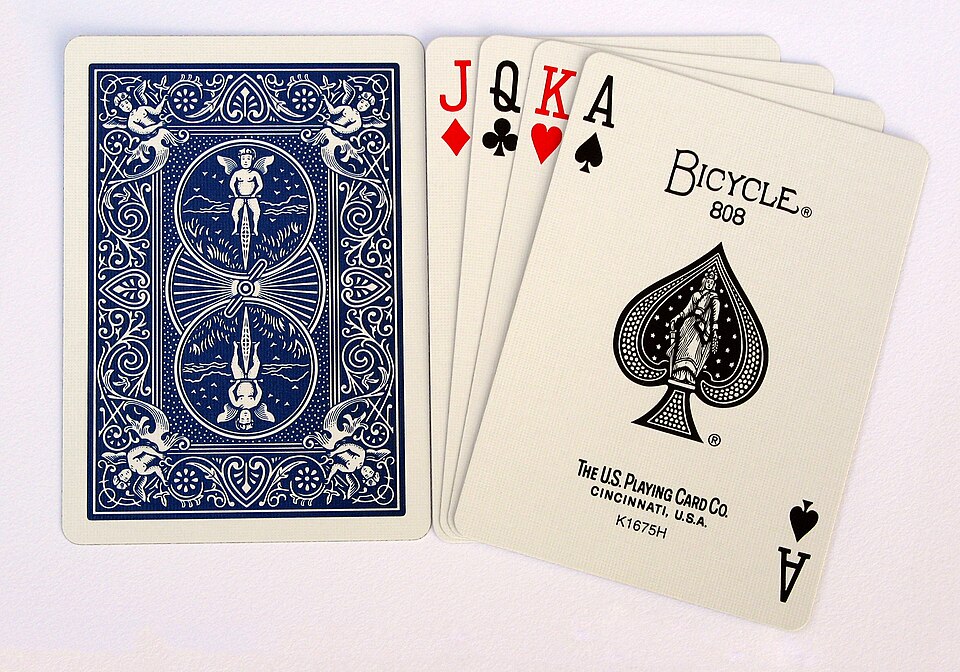

The ace is a pip card with a single pip. The standard-deck article puts it plainly: “The card with one pip is known as an Ace.” In the standard pack each ace shows a single symbol of its suit. On the ace of spades, though, many packs derived from the English pattern print an especially large pip or even a picture, and the reason is a tax.
According to Wikipedia's ace of spades article, stamp duty, which Charles I had brought to England, was extended to playing cards by Queen Anne in 1711. From 1712, one card in each pack, usually the ace of spades, was hand-stamped to show the duty had been paid. In 1765 the Stamp Office began printing the official ace of spades itself, with the royal coat of arms. The 1828 “Duty Ace”, nicknamed Old Frizzle, marked a reduced duty of one shilling. Forging the ace was a capital offence: the card maker Richard Harding was hanged for it in 1805.
In 1862 duty wrappers replaced the special ace, and makers could print any ace they liked. Most kept the ornate one, and it became the card that carries the manufacturer's name, which is what the Bicycle ace above shows. The duty itself lasted until 1960, according to Wikipedia's ace of spades article. Other countries chose other cards. Wikipedia's pip article lists the ace of clubs in the Paris pattern, the ace of diamonds in the Russian pattern, the ace of hearts in Germany (the deuce of hearts in German-suited packs) and the ace of coins in Latin-suited packs.
However large the ace's pip is drawn, it is still one pip. In every count on this page the ace counts as 1, which is also its value in cribbage.
How many pips are in a deck of cards?
220 in a standard 52-card pack. The count depends on a convention, so here it is spelled out. Count the pips in the central field of each card, with the ace as one pip. Leave out the corner indices, the suit symbols drawn beside the court figures, and any jokers.
The working
One suit: 1 + 2 + 3 + 4 + 5 + 6 + 7 + 8 + 9 + 10 = 10 × 11 ÷ 2 = 55 pips. The jack, queen and king add 0.
Four suits: 4 × 55 = 220 pips.
If you also count the index suit symbols (one in each of two corners on all 52 cards), add 2 × 52 = 104, for 324 symbols. That is a count of printed suit marks, not of pips.
Many European games use a shortened pack. Wikipedia's playing card article lists which ranks each one keeps, so the same rule gives their pip totals:
| Pack | Ranks kept | Pips per suit | Whole pack |
|---|---|---|---|
| Standard 52-card pack | A, 2–10, J, Q, K | 1+2+…+10 = 55 | 4 × 55 = 220 |
| Russian 36-card pack | A, 6–10, J, Q, K | 1+6+7+8+9+10 = 41 | 4 × 41 = 164 |
| Piquet 32-card pack | A, 7–10, J, Q, K | 1+7+8+9+10 = 35 | 4 × 35 = 140 |
| 40-card French-suited pack (NW Italy) | A, 2–7, J, Q, K | 1+2+…+7 = 28 | 4 × 28 = 112 |
| 24-card Schnapsen pack | A, 9, 10, J, Q, K | 1+9+10 = 20 | 4 × 20 = 80 |
Games that score by card value count differently, because the court cards are given a value. In cribbage the rules on pagat.com call them “pip values”: ace 1, two to ten at face value, and jack, queen and king 10 each. One suit is then worth 55 + 3 × 10 = 85, and the whole pack 4 × 85 = 340. That is the number to use if you want to check a cribbage count, not 220. Wikipedia's pip article adds that in point-trick games, where cards score their value, the points themselves are sometimes called pips.
Heart, spade, diamond and club pips, and the suits other countries use
A pip does two jobs at once. Its shape tells you the suit and the number of copies tells you the rank. Wikipedia's playing card suit article says each card “bears one of several pips (symbols) showing to which suit it belongs”. So a heart pip simply means “this card is a heart”. It has no other meaning in the rules of a game.
The four shapes are French in origin. French card makers took them from the German suits around 1480: trèfles (clovers, our clubs), carreaux (tiles, our diamonds), cœurs (hearts) and piques (pikes, our spades). The heart came over unchanged from the German suit of hearts. The playing card article suggests the clover came from the German acorn and the pike from the German leaf, and that the English names clubs and spades may be carried over from the older Latin suits. In the standard pack, hearts and diamonds are red and spades and clubs black. Four-colour packs make the suits easier to tell apart, and a common scheme uses black spades, red hearts, blue diamonds and green clubs.
Other suit systems have their own pips, and the idea of counting them is the same:
- German suits: acorns, leaves, hearts and bells, used across much of central Europe. The pip article notes that German pips have historically differed from French and English ones.
- Swiss-German suits: acorns, shields, roses and bells, developed around 1450.
- Latin suits (Spanish and Italian): swords, batons or clubs, cups and coins. These are the oldest European suits, adopted from cards brought in from Mamluk Egypt and Moorish Granada in the 1370s. The suit article says the Latin systems are told apart by the pips of the two long suits. Northern Italian swords are curved and cross each other, while Spanish swords are straight and the clubs are knobbly cudgels that do not cross (except on the three of clubs).
- Tarot trumps are the exception. They have neither pips nor court figures, though the four ordinary suits in a tarot pack do.
Pip cards, spot cards, numerals: the names
The ranks from ace (or two) to ten are called pip cards. The same article on pips gives the other names: numerals or numeral cards, number cards, spot cards and spotters. It also says the word was originally “peep”. Sources differ on whether the ace belongs in the group. The pip article counts the pip cards as one to ten, while the standard-deck article's list of terms puts “numerals or pip cards” at 2 to 10 and gives the ace a name of its own. Either way, the ace has a pip and is counted as one.
The word pip is not unique to cards. The same word names the dots on a die and the spots on a domino, and our guide to what pips are covers all three side by side. On dominoes a pip is a plain dot and each half of a tile shows 0 to 6 of them. See domino pips for the tile layouts, or dot on a domino if you came here from a crossword clue. Dice get their own page: pips on a die.
The domino sense is the one used in the free daily pips puzzle on our homepage. You place dominoes on a grid so that the pips inside each coloured region meet its rule. It uses tiles, not cards. If you can count a 7 of hearts at a glance, though, you will read domino halves just as quickly.
Questions people ask about card pips
- What are pips on playing cards?
- Pips are the suit symbols printed in the middle of a number card. Their count is the card’s rank: the 7 of hearts carries seven heart pips. The ace has one pip, and the jack, queen and king show a figure instead of a pip layout.
- Are the small symbols in the corners pips?
- No. The rank and small suit symbol in the corners are the index, added so you can read a card while it is fanned in your hand. Count only the symbols in the central field. A 7 of hearts shows seven pips, not nine.
- How many pips are in a standard deck of cards?
- 220, counting the ace as one pip and leaving out corner indices and court cards. Each suit has 1+2+…+10 = 55 pips, and four suits give 4 × 55 = 220.
- Why are some pips upside down?
- Modern cards are double-ended, so they read the same either way up. Pips in the top half point up and pips in the bottom half point down. Because the centre pips are not split evenly, the 7 still has five pips pointing up and two pointing down.
- What are cards 2 to 10 called?
- Pip cards. They are also called numeral cards, number cards, spot cards or spotters. The jack, queen and king are court cards or face cards.
Keep reading
- Dominoes with 2 playersSeven tiles each, Block vs Draw, scoring to 100, and a tile tracker for what your opponent can hold.
- How to score dominoesBlock and draw pip counts, All Fives and Muggins ends, rounding to five, and a free scorer.
- Domino gamesTwelve domino games compared by players, set and objective, with a picker for the set you own.
- Mexican Train dominoes rulesThe deal for 2–10 players, the engine for all 13 rounds, markers, doubles, scoring and house variants.
Or go back to today's pips puzzle.